Smart Concrete Companies Are Quietly Making This Move Right Now
"One resists the invasion of armies; one does not resist the invasion of ideas."
– Victor Hugo
The Iran war isn’t just another geopolitical headline.
It’s an energy reset.
And if you’re in concrete, you’re already feeling it whether you realize it or not.
Every time things tighten up in the Middle East, oil gets a premium layered on top. Not because supply disappears overnight, but because risk gets priced in immediately. That’s what we’re seeing right now.
Meanwhile, back here in the U.S., natural gas is sitting in oversupply. Cheap. In some places, it’s practically being given away just to move it.
That gap matters.
Because at the end of the day, energy is energy. Heat is heat. Markets don’t tolerate massive price differences for long. They correct.
The correction is already underway. It is just not obvious yet to most of the construction industry.
But the smart concrete companies are paying attention. They are asking a simple question.
Why are we still running everything on diesel?
Let’s put real numbers to it, because this is where it starts to click.
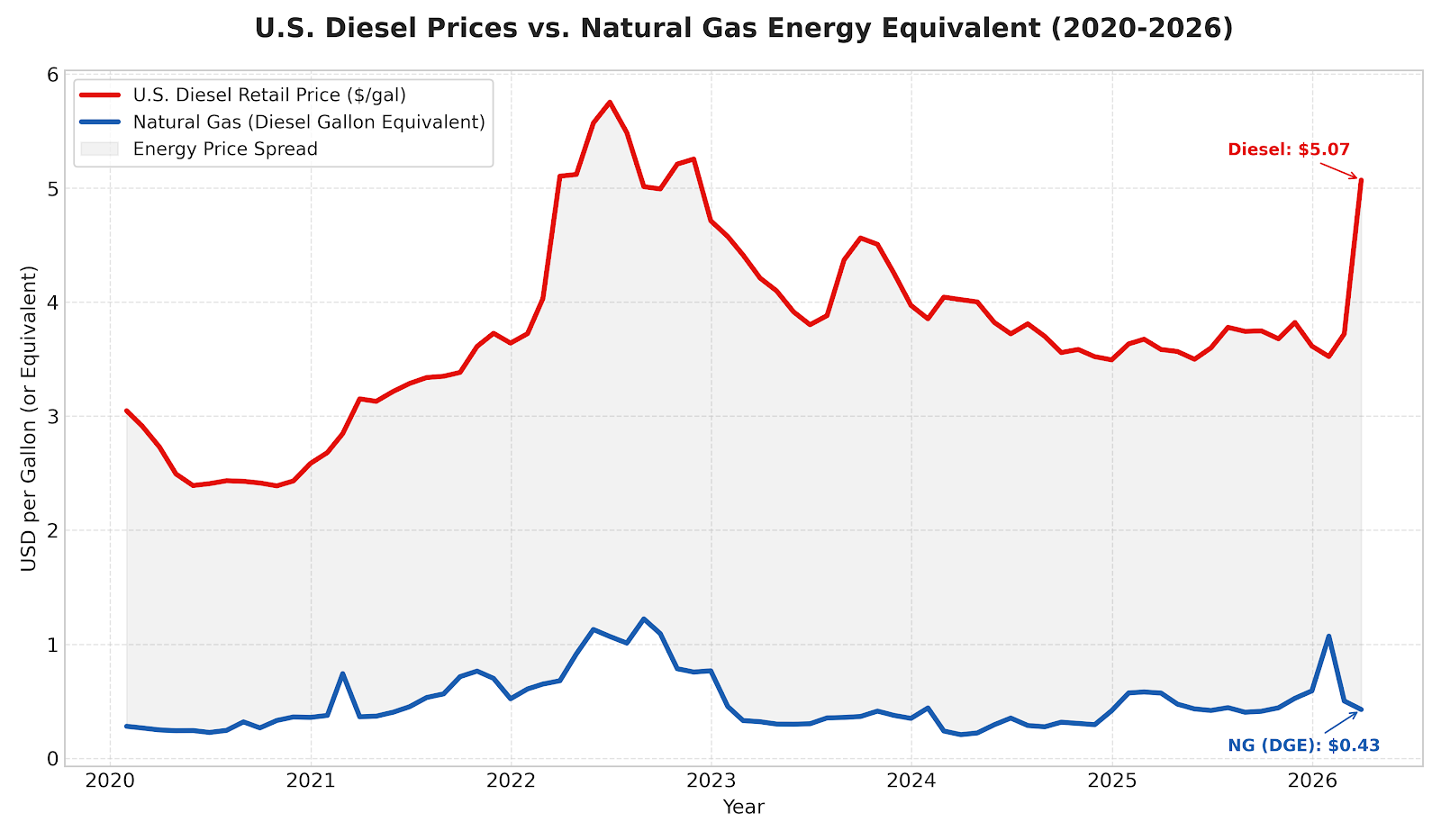
Right now, diesel is sitting around $5.07 per gallon. Natural gas is about $3.08 per MMBtu. But those are not apples to apples, so you have to convert it. One gallon of diesel has roughly 138,700 BTUs. When you run that conversion, natural gas comes out to about $0.43 per diesel gallon equivalent.
That is the spread.
$0.43 vs. $5.07.
That is not a normal market. That is a massive arbitrage, and markets do not let those sit around forever.
Now yes, diesel includes refining, transportation, and taxes. Natural gas at Henry Hub does not. You still have to compress it, move it, and build out the infrastructure to use it.
But even after accounting for that, it is still dramatically cheaper.
And that is the only part that really matters.
Industries do not switch fuels because of narratives. They switch when the math forces them to. And the math is starting to force it.
This is how these shifts always happen. Not with some big announcement, but with margins getting squeezed until someone finds a better way. Then everyone else follows.
We are already seeing it in heavy transport and oilfield fleets. They are moving toward compressed natural gas, dual-fuel systems, and fuel-flexible engines because it lowers operating costs in a meaningful way.
Concrete is no different.
Most mixer trucks are getting somewhere in that 3 to 4 miles per gallon range under real jobsite conditions. Fully loaded, stop and go, all day long. That fuel burn is baked into every yard you deliver.
And when diesel spikes, it hits you twice. First at the pump, then again through fuel surcharges. You have seen this movie before. 2008. 2022. And now again.
But this time feels different.
Because there is a real alternative sitting right there.
Natural gas.
Not the “green” version people like to talk about. The cheap version. The abundant version. The version that exists because oil drilling keeps producing it whether we want it or not.
That is the part most people miss.
Oil and gas come out of the ground together. Right now, oil is valuable, so we keep drilling. That means we keep flooding the market with natural gas as a byproduct.
That is why the price is so disconnected.
And that disconnect does not last forever.
So what happens?
Industries start switching. Quietly at first, then all at once.
Now think about what that means for a concrete producer.
You have mixer trucks getting 3 to 4 miles per gallon, running all day, burning expensive diesel. Every yard you deliver is tied to that cost.
Now imagine cutting the fuel side of that equation in half. Or more.
That is not incremental. That is a competitive advantage.
And it does not just lower cost. It stabilizes it.
Fuel is one of the biggest wildcards in ready-mix. When diesel swings, everything swings. Delivery costs. Material costs. Project budgets. Owner confidence.
Natural gas is different. It is domestic, abundant, and far less exposed to global chaos.
That matters when you are trying to price work months or years out.
The reason this opportunity even exists is because of that imbalance between oil and gas. And like every other imbalance in energy markets, it eventually gets arbitraged away.
Either natural gas prices rise, diesel prices fall, or more industries start switching fuels to close the gap.
In reality, it is usually a mix of all three.
But the switching is already underway.
The Iran situation just accelerates it. Higher oil prices, more volatility, more uncertainty. It all puts pressure on diesel and makes natural gas look even more attractive.
This is not some future trend.
It is happening right now.
The only question is who in the concrete industry moves first.
Because the companies that figure this out early are not just going to save money on fuel. They are going to operate differently, price work differently, and compete differently.
And everyone else is going to feel it.

Tariffs, Tankers, and the Cost of Moving Energy