They Said the Internet Would Kill Jobs Too. Here We Go Again with AI.
“We tend to overestimate the effect of a technology in the short run and underestimate the effect in the long run.”
— Roy Amara
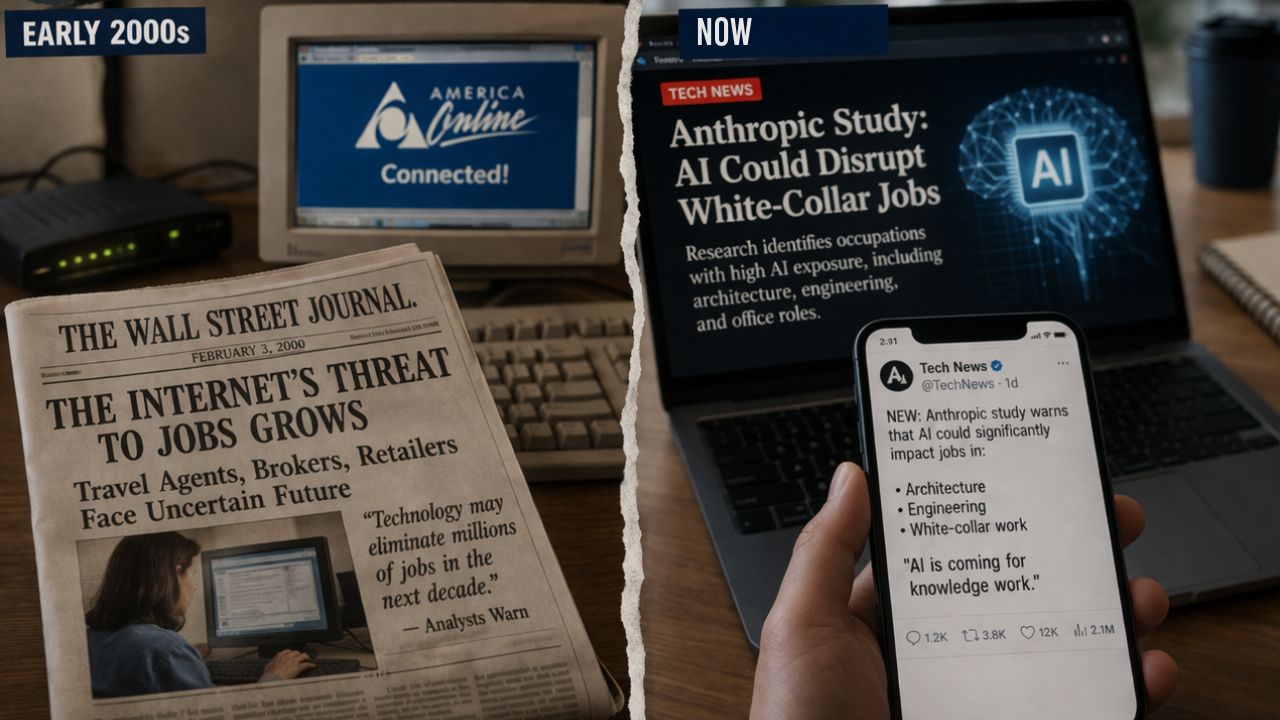
Last week I saw a post making the rounds about an Anthropic study. The takeaway was familiar. Architecture, engineering, and white collar jobs are all at risk. It felt like something we have seen before.
Back in the early 2000s, people were saying the same thing about the internet. Travel agents, stockbrokers, retail workers, and bank tellers were all supposed to disappear. The message was simple. Technology was going to wipe out entire professions.
There was truth in it, but it was incomplete.
Those jobs did not vanish. They changed. In many cases, they improved for the people who were willing to adapt. The low value versions of those roles got squeezed out, while the higher value versions became more important.
Travel agents stopped booking simple flights and turned into specialized planners for complex trips. Stockbrokers stopped taking orders and became advisors focused on strategy. Retail did not go away. It shifted into e-commerce, distribution, and logistics at a scale that most people underestimated.
The internet did not eliminate jobs. It eliminated friction.
That distinction matters more than people realize.
Now we are watching the same pattern play out again with AI. The headlines are louder this time, and the predictions are coming faster. There is a lot of confidence in what AI will do, and not nearly enough discussion about how long real world change actually takes.
So I went and read the Anthropic study that everyone is posting. Not just the chart.
The full report: Anthropic Study
The biggest takeaway is not what people are sharing. The study finds no measurable increase in unemployment in the jobs most exposed to AI, even after several years of rapid adoption.
That should slow people down.
At the same time, the study points out that AI is only being used for a fraction of what it could theoretically do. There is a large gap between capability and actual use. That gap is where most of the confusion is coming from.
This is exactly what happened with the internet. Everyone could see what it might become, but almost no one understood how uneven the rollout would be.
Adoption takes time. Integration takes longer. Real change happens slower than the headlines suggest.
Because real work is not theoretical.
It is messy. It involves constraints, people, risk, and accountability. It happens in environments where mistakes cost money and sometimes a lot more than money.
That is especially true in construction.
AI can help with submittals, scheduling, documentation, and analysis. Those are real improvements and they will continue to get better. There is value there and it will compound over time.
But AI is not walking a jobsite. It is not making a call when something goes sideways. It is not coordinating trades under pressure or dealing with the reality of a pour that does not go as planned. It is not owning the outcome.
That still matters.
What is actually happening is more subtle. Low value and repetitive tasks are getting compressed. Entry level work is starting to shift. The roles that relied on processing information without much judgment are the ones feeling pressure first.
That does not mean the profession is going away. It means the path into the profession is changing.
We saw this with the internet. We are seeing it again now.
The people who struggled were the ones who stayed in the low value part of the work. The people who did well moved up the value chain. They got closer to decision making, closer to relationships, and closer to outcomes that could not be easily automated.
That is the real shift.
So when someone asks whether they should go into construction, architecture or engineering because of AI, the answer is not no. The answer is yes but understand what is changing.
Learn the tools. Pay attention to how the work is evolving. Do not build your career around tasks that can be easily replicated. Build it around judgment, experience, and accountability.
The closer you are to real world outcomes, the harder you are to replace.
That was true when the internet came out.
It is still true now.
We have seen this before. The only difference is we are calling it something new.
Smart Concrete Companies Are Quietly Making This Move Right Now