10 Reasons Virginia Power Bills Are Going Up, and Data Centers Are Just One
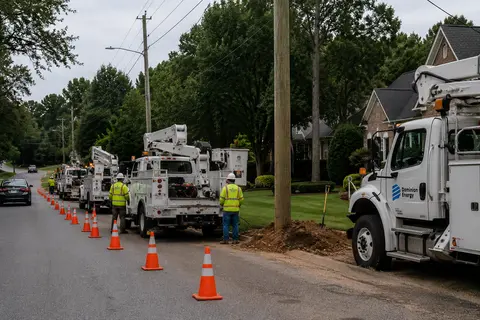
I was driving home from work the other day and was almost to the entrance of my neighborhood. The right lane was coned off, and there were four or five Dominion trucks lined up.
Crews were setting new power poles.
Nothing dramatic. No press conference. No politician at a podium. Just utility crews doing utility work.
But it made me wonder.
What are those poles for?
Are they replacing old poles? Are they adding new lines? Are they preparing for more load? Are they upgrading a part of the grid most of us never think about until the power goes out?
That little scene reminded me of something.
Everyone wants to blame data centers for rising electric bills because data centers are easy to hate. Big buildings. Big tech. Big power use. Big target.
And to be clear, data centers use a ton of electricity. Virginia has a lot of them. They are absolutely part of the story.
But are they the whole story?
No.
Not even close.
So I started looking through recent Dominion Energy and Virginia State Corporation Commission filings to see what is actually driving costs higher.
What I found is pretty simple.
Virginia’s power bill problem is not one thing. It is a stack of things.
It is infrastructure. It is data centers. It is electrification. It is clean energy policy. It is fuel cost. It is transmission. It is distribution. It is shutting down older power plants and trying to replace them with something else.
It is a lot more than “those ugly data centers made my bill go up.”
Here is what is really driving the cost stack.
1. Normal replacement work
This is the boring stuff.
Old poles get replaced. Wires get changed. Transformers age out. Substations need work. Equipment reaches the end of its useful life.
Nobody gets excited about this. Nobody builds a political campaign around replacing utility poles.
But the grid is physical infrastructure.
It wears out.
And when utility crews replace it, somebody pays for it.
That somebody is us.
This may have been what I saw on my way home. Maybe those poles were not for some big new user. Maybe they were just old poles that needed to come down.
Either way, the cost is real.
2. Storm hardening and reliability
Everybody wants cheap power.
Everybody also wants the lights to stay on during storms.
Those two things fight each other.
Stronger poles cost money. Better lines cost money. Vegetation management costs money. Automated switches cost money. Undergrounding in certain areas costs money. Cybersecurity costs money. Physical security costs money. Faster outage restoration costs money.
Reliability is not free.
We just pretend it is until a storm knocks the lights out.
Then everyone wants the utility crews out there immediately.
Fair enough.
But that system has to be built and maintained before the storm shows up.
3. Local distribution upgrades
This is the neighborhood-level stuff.
Poles. Wires. Transformers. Meters. Circuits. Substations.
The things that actually get electricity to homes and businesses.
Most people do not think about the distribution system. They just flip the switch and expect the light to come on.
But when neighborhoods grow, homes get bigger, businesses expand, EV chargers show up, heat pumps get installed, and more electric load gets added, the local grid has to keep up.
That may mean replacing transformers. That may mean bigger wires. That may mean new poles. That may mean upgraded circuits. That may mean substation work.
Again, not exciting.
Still expensive.
4. Electrifying everything
This one gets ignored.
We are pushing more things onto the electric grid.
Cars. Trucks. Buses. Warehouses. Ports. Heat pumps. Water heaters. Manufacturing. Homes. Buildings. Industrial equipment.
Even my neighbor’s Tesla.
And no, I am not yelling at my neighbor for plugging in his car. That is not the point.
The point is this: if more cars, homes, buildings, and businesses are being pushed onto the electric grid, then the grid has to get bigger.
More wires. More poles. More transformers. More substations. More generation. More backup. More everything.
You cannot tell everyone to plug everything in and then act shocked when the power company needs to spend money.
That is not how infrastructure works.
The electric grid was already important. Now we are asking it to do more.
A lot more.
5. Fuel and purchased power costs
This one sounds like utility-speak, so let’s put it in normal words.
Fuel costs are what Dominion pays for the fuels used to make electricity. Natural gas. Coal. Uranium. Whatever is being used in the generation mix.
Purchased power is electricity Dominion buys from the market or from other producers when it needs more power than its own system is producing, or when market power is cheaper or required.
This matters because Dominion does not control all of those costs.
Natural gas prices move. Coal prices move. Cold weather can spike demand. Hot weather can spike demand. Market prices move. PJM costs move.
And if Dominion has to buy expensive power to keep the lights on, that cost does not disappear.
It gets passed through to customers.
Dominion says it does not earn a profit on fuel and power capacity costs.
Fine.
But the customer still pays the bill.
So when someone says, “My bill went up because of data centers,” maybe that is part of the story. But fuel and purchased power are part of the story too.
That is why blaming one big ugly data center building is too easy.
6. PJM capacity costs
This one is even more confusing, but it matters.
PJM is the regional grid operator. Think of PJM as the traffic controller for electricity across a big chunk of the eastern United States, including Virginia.
The capacity market is not about the electricity you used yesterday. It is about making sure enough power is available in the future when demand peaks.
Hot summer day. Cold winter morning. Everybody is using power.
The grid cannot say, “Sorry, we did not plan for this.”
So PJM pays power plants and other resources to be available.
That is capacity.
If the grid gets tight, capacity gets more expensive. If old power plants retire, capacity gets tighter. If demand grows, capacity gets tighter. If new generation cannot get built fast enough, capacity gets tighter.
And when capacity gets expensive, customers eventually feel it.
This is one of those hidden costs that most people never think about until their bill goes up.
But it is a real part of the bill story.
7. Shutting down coal and replacing firm power
This is one of the big ones.
Coal plants were not pretty. They were not loved. But they were firm power.
You could run them when needed. They had fuel onsite. They supported the grid.
When you shut that down, you still need power.
You need replacement generation. You need backup. You need transmission. You need capacity. You need reliability resources.
You may need gas plants, solar, batteries, imports, demand response, or all of the above.
That replacement stack costs money.
People were sold the idea that the energy transition would be clean, easy, and cheap. The filings suggest otherwise.
Maybe people think shutting down coal is worth the cost.
Fine.
Make that argument.
But stop pretending there is no cost.
There is always a cost.
8. Offshore wind, onshore wind, and renewable mandates
This one deserves more attention.
Dominion’s Coastal Virginia Offshore Wind project is not some small science project. It is a massive infrastructure project.
The current cost estimate is around $11.4 billion to $11.5 billion.
Virginia has about 8.88 million residents.
Simple math says that project equals roughly $1,280 to $1,295 per Virginia resident.
That does not mean every Virginian gets a bill tomorrow for $1,295. Utility cost recovery is more complicated than that.
Costs are recovered over time. Costs are assigned across customer classes. There are riders, financing costs, tax credits, fuel savings claims, depreciation, allowed returns, and all the usual utility accounting fun.
But the scale matters.
An $11 billion-plus wind project is not background noise.
It belongs in the power bill conversation.
Dominion also has clean energy riders tied to solar, onshore wind, energy storage, renewable energy credits, and power purchase agreements.
That is where we need to be careful.
Offshore wind is easy to isolate.
Onshore wind is not as clean.
In public rate materials, onshore wind often gets bundled with solar, storage, renewable energy credits, and third-party power purchase agreements.
So I am not going to pretend we can cleanly say, “Onshore wind costs every Virginia resident X dollars.”
That would be sloppy.
What we can say is this:
Virginia’s renewable mandates are not free.
Whether it is offshore wind, solar, onshore wind, battery storage, renewable energy credits, or power purchase agreements, those costs show up somewhere.
Maybe you think they are worth it.
Maybe you do not.
But pretending they are not part of the bill is nonsense.
9. Transmission upgrades
Transmission is the highway system for electricity.
If load is growing in Virginia, power has to get there.
That means new lines, bigger lines, substations, interconnections, transformers, breakers, controls, land rights, permitting, engineering, crews, and years of work.
This is where data centers matter.
But data centers are not the only reason transmission gets expensive.
Load growth matters. Generation location matters. Coal retirements matter. Renewable buildout matters. Reliability standards matter. Regional power flows matter.
You can see the point pretty clearly on this map: OpenGridWorks
Power plants are not magic. Data centers are not magic. Transmission is not magic.
It is physical infrastructure.
Steel. Concrete. Wire. Land. Permits. Substations. Transformers. Labor.
And when the system needs more of it, somebody pays.
10. Data centers
Now we get to the villain everyone wants to talk about.
Yes, data centers use a ton of electricity. Yes, Virginia has a lot of them. Yes, they are driving major load growth. Yes, they require major utility planning.
And yes, they should pay their own way.
But blaming every higher power bill on data centers is lazy.
The better question is this:
Are data centers paying for the costs they create, or are those costs being quietly spread across everyone else?
That is the real fight.
The Virginia SCC seems to understand this problem. It approved a new large-user rate class for customers demanding 25 megawatts or more.
That includes data centers.
The point is to recover the unique costs of serving massive users and reduce cost shifting onto other customer classes.
Translation:
If there were no cost-shifting concern, there would be no need for the new rate class.
That does not mean every data center cost is currently being dumped on residential customers. But it does mean the risk is real enough for the regulator to act.
So can we figure out exactly how much each data center adds to your power bill?
Not from the public information I have seen.
At least not honestly.
You would need the project’s contracted load, interconnection cost, substation cost, transmission upgrades, distribution upgrades, contract terms, rate class, and how the SCC allowed those costs to be recovered.
That is not sitting in a neat little table called, “How much this data center costs Grandma.”
But we can track the bigger issue.
Are the costs being assigned to the customers causing them?
Or are they being buried in the broader system and spread across everyone?
That is the question.
The real power bill story
Data centers are not innocent. They are a major load-growth driver.
But they are not the only thing driving your power bill higher.
The real story is bigger.
We are electrifying more of the economy. We are retiring older dispatchable power plants. We are building replacement generation. We are upgrading transmission. We are replacing distribution infrastructure.
We are paying fuel and purchased power costs. We are paying PJM capacity costs. We are building offshore wind. We are complying with renewable mandates. We are hardening the grid.
And yes, we are serving data centers.
That is the cost stack.
Data centers are part of it.
They are not the whole thing.
The public was sold a simple fairy tale.
Electrify everything. Shut down coal. Build renewables. Add data centers. Keep bills low. Never have outages.
That math was never going to work.
Data centers are the easy villain because you can point to a big windowless building and blame Big Tech.
But your power bill is not being driven by one villain.
It is being driven by a grid that is being asked to do everything, everywhere, all at once, while politicians pretend physics is optional.
So the next time someone says, “My power bill is going up because of data centers,” I would ask a better question.
Compared to what?
Compared to shutting down coal?
Compared to building offshore wind?
Compared to electrifying cars, homes, ports, warehouses, and industry?
Compared to replacing old poles and transformers?
Compared to buying power when the market gets tight?
Compared to paying for capacity because the grid needs backup?
Compared to rebuilding the electric system while pretending it should still be cheap?
Data centers are part of the bill.
But they are not the whole bill.
And if we are going to have an honest conversation about Virginia power costs, we should stop pretending they are.
Notes and Sources
Virginia SCC order on Dominion Energy Virginia biennial review, including GS-5 large-user rate class for customers demanding 25 megawatts or more and approved residential bill impacts: https://www.scc.virginia.gov/about-the-scc/newsreleases/release/scc-issues-order-on-dev-biennial-review-2025/scc-rules-in-dev-biennial-review-case.html
Virginia SCC notice on Dominion fuel factor request, including projected fuel and purchased power capacity expenses of approximately $1.958 billion and projected unrecovered fuel deferral balance of $204.5 million: https://www.scc.virginia.gov/about-the-scc/newsreleases/release/scc-to-consider-dominion-fuel-factor-request/scc-sets-hearing-on-dev-fuel-factor-request.html
PJM 2026 Load Forecast Report: https://www.pjm.com/-/media/DotCom/library/reports-notices/load-forecast/2026-load-report.pdf
Open Grid Works map showing power plants, transmission, substations, and data centers: https://opengridworks.com/power-plants?layers=tx%2Cdatacenters%2Chpoints%2CrowTx%2CrowSubs&panel=closed&dcIxpOn=1
Dominion Energy Coastal Virginia Offshore Wind project update: https://news.dominionenergy.com/press-releases/press-releases/2025/Coastal-Virginia-Offshore-Wind-CVOW-Project-Part-of-Comprehensive-All-of-the-Above-Energy-Strategy-to-Affordably-Meet-Growing-Energy-Needs-Continues-on-Schedule-Cost-Updated/default.aspx
Reuters reporting on updated Coastal Virginia Offshore Wind cost estimate around $11.4 billion: https://www.reuters.com/business/energy/nextera-ceo-says-feels-very-good-about-dominion-offshore-wind-project-2026-05-18/

Editor-in-Chief, Concrete Logic
Seth Tandett is based in Richmond, Virginia, and has spent years working in the concrete construction industry across central and southern Virginia. His experience includes structural concrete work on multi-level frames, data centers, federal facilities, and other large-scale projects.
Today, Seth works in business development for Baker Construction and hosts the Concrete Logic Podcast, where he asks direct questions about what is really happening in the concrete industry.
Outside of work, Seth spends time studying economics, reading American history, and hunting waterfowl.
On the Concrete Logic Podcast, Seth brings the same approach he uses in the field: ask better questions, challenge weak answers, and focus on what actually matters in concrete.
How Did America Become the World's Largest LNG Exporter?