Are Concrete Workers Funding Wall Street’s Exit Through Their 401(k)s?
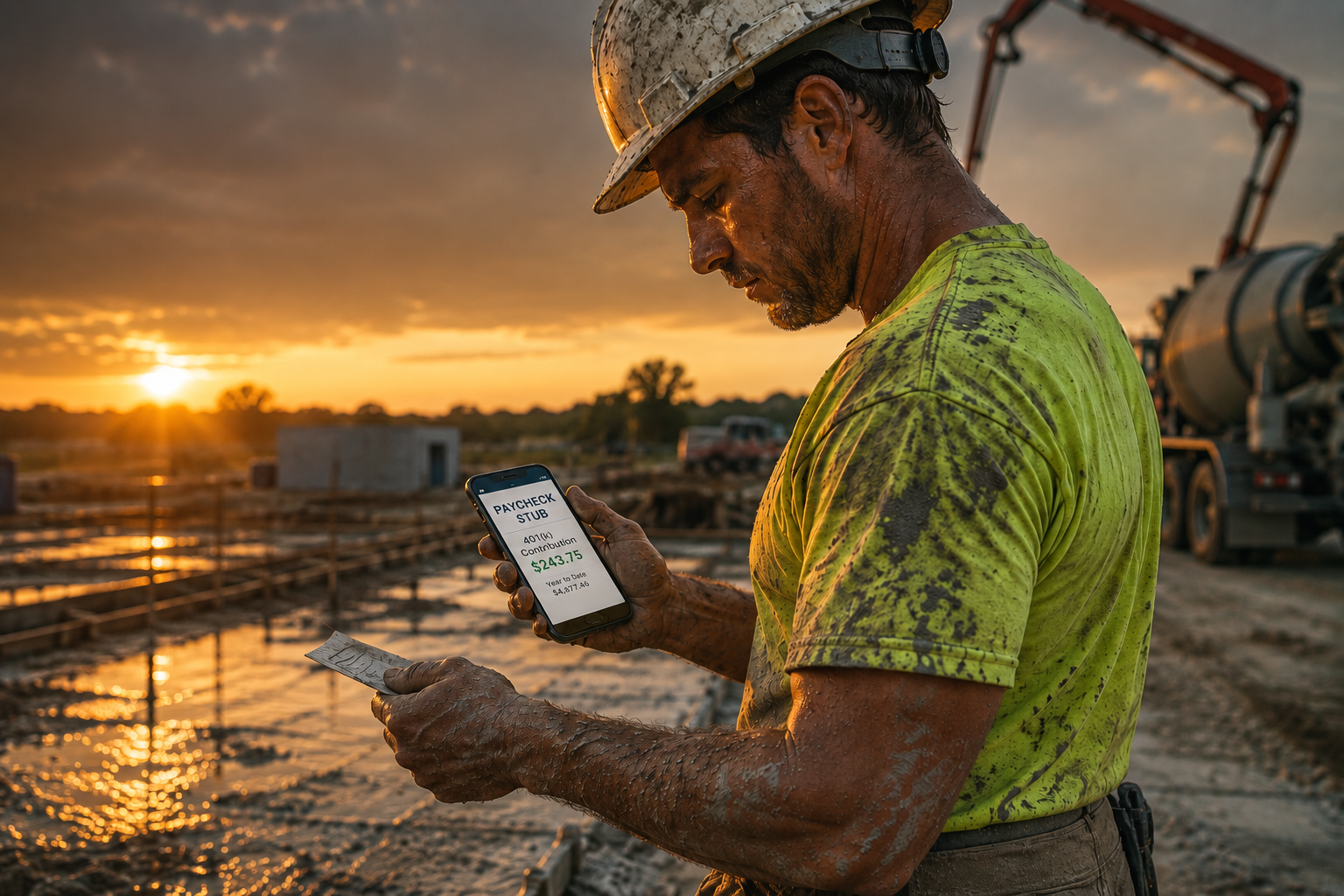
You work hard.
The concrete business is not easy. Early mornings. Long days. Weather problems. Schedule pressure. Phone calls after hours. Plenty of stress.
Still, every paycheck, you do the responsible thing.
You put money into your 401(k).
Your company probably gave you a list of funds and told you to pick one. Maybe you chose an S&P 500 index fund. Maybe it was a target-date fund with a name like “Retire in 2040” or “Retire in 2050.”
You contribute. Your company may match part of it. The money comes out automatically.
Then you get back to work.
Concrete Logic usually talks about materials, construction and the problems we face in the field. But the money you earn in this industry and where it goes every payday deserves some attention too.
So what is really happening with that money?
Your Money Does Not Just Sit There
Your 401(k) contribution is used to buy investments.
A target-date fund usually owns a mix of stock and bond funds. Many of those stock funds track indexes such as the S&P 500 or the total U.S. stock market.
That means your fund is buying companies according to a set of rules.
You are not personally choosing every stock. You may not know which companies are inside the fund. You may not know what price the fund is paying.
The buying still happens.
Every payday.
Now think about what happens when a huge private company like SpaceX goes public.
What Is an IPO?
IPO stands for initial public offering.
It is the point when a privately owned company begins selling shares to the public.
Before the IPO, the company is mainly owned by founders, employees, venture-capital firms, wealthy investors and large institutions.
After the IPO, regular investors can finally buy shares through the stock market.
By then, the earliest investors may have been in the company for years.
They got in before the public had access.
The Early Investors Get the First Shot
Private investors take real risk.
They put money into companies that may fail. Their shares can be difficult to sell. They may wait years before seeing a return.
But they also get access at much lower valuations.
SpaceX raised private money for years. It also held private share sales that allowed some employees and early investors to sell portions of their stock before the company ever went public.
As the business grew, the valuation kept climbing.
Then SpaceX went public.
The public did not get the early price.
The public got the price after years of private investment, growth, publicity and rising valuations.
SpaceX’s IPO was made up of newly issued shares, so the early investors were not all cashing out directly on the first day.
What is the difference?
The IPO created a public market where those early shares may eventually be sold.
Many insiders are restricted from selling immediately. Those restrictions expire over time. When they do, early investors can begin selling shares into the public market.
Who is there to buy them?
You may be.
We Have Seen This Before
Coinbase went public in 2021 through a direct listing.
A direct listing allows existing shareholders to sell shares directly into the public market. Coinbase did not have the same traditional insider lockup used in many IPOs.
On the first day of trading, CEO Brian Armstrong sold shares worth nearly $300 million. Other early shareholders sold as well.
The public bought those shares.
Rivian followed a more traditional IPO path.
The electric-vehicle company went public in 2021 at $78 per share. The stock quickly climbed to around $180.
Early investors were restricted from selling for several months.
When that restriction expired, Ford began selling millions of Rivian shares.
By then, the stock had already fallen sharply from its high.
Airbnb also went public in 2020.
Its IPO price was $68 per share. The stock opened for public trading at $146.
The public paid more than twice the IPO price on the first day.
Several years later, Airbnb was added to the S&P 500. Once that happened, funds tracking the index had to buy it.
That included funds held inside retirement accounts.
The Automatic Buyer
This is the part most workers never think about.
When a company enters a major index, funds that track that index must own it.
The fund manager is not necessarily deciding whether the stock is a bargain.
The fund is following the index.
Your paycheck hits your 401(k). Your contribution goes into the fund. The fund buys the companies inside the index.
That process repeats across millions of workers and millions of paychecks.
You may not know that a new company was added.
You may not know that early investors are beginning to sell.
You may not know what valuation the fund is paying.
But your retirement money may still be part of the buying.
Is Your 401(k) the Exit?
This does not mean your 401(k) is a bad idea.
Index funds have helped ordinary workers build wealth at a low cost. Early investors also deserve a return for taking risks before anyone else was willing to invest.
But you should understand the system.
A private company raises money from early investors.
The valuation rises.
The company goes public.
The public begins buying.
The company may eventually enter major indexes.
Retirement funds begin buying it automatically.
Early investors gain a liquid market where they can sell their shares.
That does not mean every IPO is rigged. It does not mean every early investor is dumping stock on unsuspecting workers.
It does mean your 401(k) is doing more than quietly saving money for retirement.
It is supplying steady buying power to the stock market with every paycheck.
You work the early mornings.
You deal with the long days.
You carry the stress.
You keep making the contribution.
The question is simple:
Are you buying into America’s best companies, or are you becoming the reliable buyer early investors were waiting for?

Editor-in-Chief, Concrete Logic
Seth Tandett is based in Richmond, Virginia, and has spent years working in the concrete construction industry across central and southern Virginia. His experience includes structural concrete work on multi-level frames, data centers, federal facilities, and other large-scale projects.
Today, Seth works in business development for Baker Construction and hosts the Concrete Logic Podcast, where he asks direct questions about what is really happening in the concrete industry.
Outside of work, Seth spends time studying economics, reading American history, and hunting waterfowl.
On the Concrete Logic Podcast, Seth brings the same approach he uses in the field: ask better questions, challenge weak answers, and focus on what actually matters in concrete.

Would Banning Diesel Exports Actually Lower Diesel Prices?