The Hidden Cost of Low-Carbon Concrete: Someone Has to Replace the Energy
The energy didn't disappear. It moved. | OpenAI
If you listened to EP #159, you heard the news: a large swath of cement manufacturers including ones in are making Type I/II cement available again.
The market spoke.
Contractors complained.
Ready-mix producers complained.
Owners complained.
Some state DOTs pushed back.
And now we’re starting to see cement manufacturers respond.
The interesting part is not whether Type I/II is coming back.
The interesting part is what happens next.
Because if Type IL cement has truly been the source of all the industry’s recent headaches, then the next few years should be pretty smooth.
No more excessive cracking.
No more strange set times.
No more low breaks.
No more scaling concerns.
No more finger-pointing.
At least that’s the logic.
As Rich Szecsy pointed out on Episode 159, many of the issues currently blamed on Type IL existed long before Type IL ever showed up. Low breaks, cracking, set time problems, and durability issues have been part of concrete construction for decades.
That’s not a defense of Type IL.
It’s a reminder that concrete has always been complicated.
And that’s where I think the industry misses the bigger lesson.
It is our belief that almost any cement can produce good concrete.
Type I.
Type II.
Type IL.
Blended cements.
Future low-carbon cements that haven’t even been commercialized yet.
The challenge isn’t whether good concrete can be produced.
The challenge is understanding what must be done to get there.
Because when you remove clinker from cement, you’re removing something important.
You’re removing energy.
You’re removing carbon.
You’re removing part of the chemistry that has traditionally helped concrete perform.
That missing energy doesn’t just disappear.
Somebody has to replace it.
The question is who?
Sometimes it falls on the contractor.
Longer curing.
More protection.
More attention to finishing.
More labor.
More equipment.
More risk.
Sometimes it falls on the ready-mix producer.
More admixtures.
More SCM optimization.
More testing.
More quality control.
More trial batches.
More engineering.
Sometimes it falls on the owner.
Longer schedules.
Higher material costs.
Additional performance requirements.
More inspection.
More uncertainty.
The point is simple.
You can absolutely produce quality concrete with lower-carbon cements.
The industry proves that every day.
But somewhere in the process, someone is replacing the energy that was removed.
Maybe it’s chemistry.
Maybe it’s labor.
Maybe it’s time.
Maybe it’s money.
Usually it’s some combination of all four.
That’s why I’ve always struggled with the idea that lower-carbon cement automatically means lower impact.
Impact on whom?
The cement plant?
The ready-mix producer?
The contractor?
The owner?
The taxpayer?
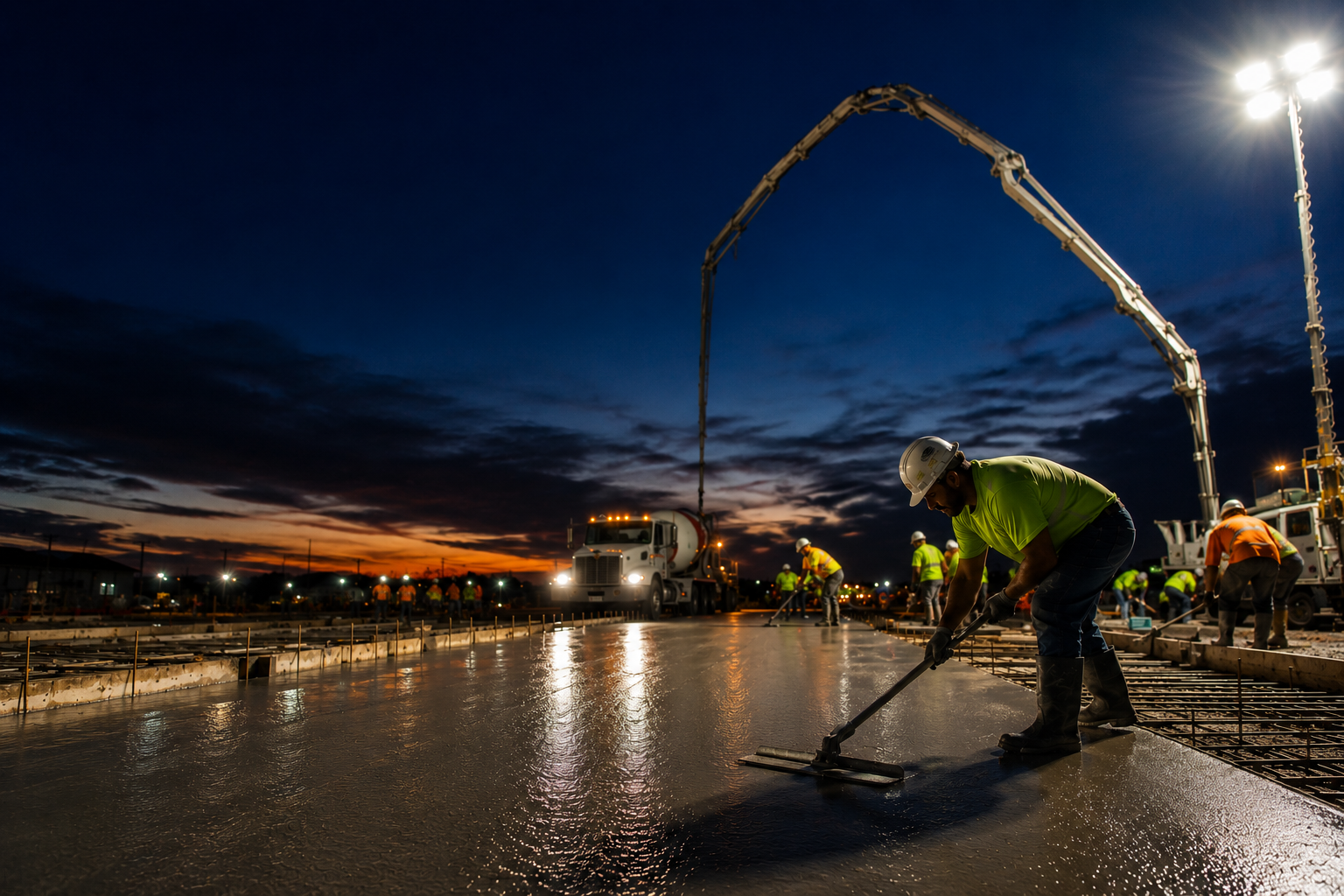
The guy trying to finish a slab before midnight?
Those costs don’t disappear.
They simply move.
And that’s the conversation I wish the industry would have more often.
Not whether Type IL is good or bad.
Not whether Type I/II is making a comeback.
Not whether a laboratory can produce a successful test result.
The real question is this:
When we remove clinker from cement, who is replacing that lost energy, and what does it actually cost?
Because concrete has always obeyed the same law.
You don’t get something for nothing.
You just decide where the bill gets sent.

Editor-in-Chief, Concrete Logic
Seth Tandett is based in Richmond, Virginia, and has spent years working in the concrete construction industry across central and southern Virginia. His experience includes structural concrete work on multi-level frames, data centers, federal facilities, and other large-scale projects.
Today, Seth works in business development for Baker Construction and hosts the Concrete Logic Podcast, where he asks direct questions about what is really happening in the concrete industry.
Outside of work, Seth spends time studying economics, reading American history, and hunting waterfowl.
On the Concrete Logic Podcast, Seth brings the same approach he uses in the field: ask better questions, challenge weak answers, and focus on what actually matters in concrete.
Are We Reducing Concrete's Carbon Footprint or Just Moving It Somewhere Else?