Who Really Pays for Construction Change Orders?
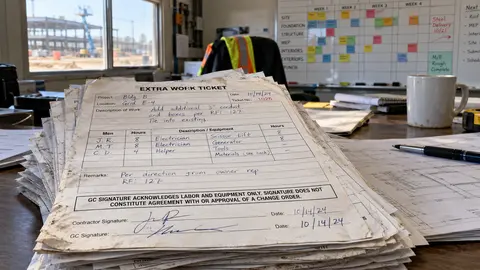
Signed for the hours. Not the dollars.
Five questions we'll answer:
- Why do some contractors count on change orders to improve their profit margins?
- Are data-center owners becoming more selective about construction spending?
- How long does it actually take to get paid for changed work?
- What happens when a contractor is expected to perform disputed work?
- Is counting on change orders a reasonable bidding strategy?
Betting on Change Orders
I've been in the concrete business for over 25 years, and one thing I've seen throughout my career is contractors bidding projects with the expectation that they'll make up some of their profit through change orders.
I've never been a fan of that approach, but I understand why it happens. Competition gets aggressive, especially when a market is as hot as data centers have been. Contractors want to get their foot in the door, keep their people busy, and establish relationships with owners and general contractors.
Sometimes that means taking a project at a thinner margin than they'd normally accept, figuring there will be opportunities to improve it later.
The problem is that those opportunities aren't guaranteed. And even when legitimate changes occur, collecting the money can be a much bigger challenge than some contractors anticipate.
The Data Center Market Is Changing
There's no question that data centers have created tremendous opportunities for the construction industry. But I think contractors need to pay attention to what is happening on the ownership side.
Microsoft's October 28, 2026, earnings report offers an interesting example.
The company reported $45.2 billion in capital expenditures for the quarter, below its previous expectation of more than $50 billion. Microsoft attributed part of that difference to delays in third-party capacity deliveries.
Now, before anyone interprets that as the data-center market falling apart, Microsoft also reported 48% growth in Azure revenue. Demand remains strong.
But there's a difference between demand for data centers and how quickly, efficiently, and profitably those facilities can be delivered.
My concern is what happens as owners become more disciplined about spending.
From what I'm seeing, owners are becoming increasingly sophisticated in evaluating construction costs, including change orders. They're asking more questions, challenging pricing, and expecting contractors to substantiate requests.
That's not necessarily a bad thing. Owners should understand what they're paying for.
However, when owners push back on the GC, that pressure frequently makes its way down to the specialty contractors.
And that's where things get interesting.
The Work Happens Before the Money
Let's say a concrete contractor is working on a large industrial or data-center project.
The engineer changes the reinforcing requirements for a foundation. It's legitimate added scope, but the project schedule doesn't allow everyone to spend the next month negotiating the price.
The GC needs the contractor to proceed.
Meanwhile, the GC may be facing contractual milestones and liquidated damages if the project is delayed. Depending on the subcontract, some of that schedule risk may also fall on the concrete contractor.
So the work gets performed, and the paperwork catches up later.
Except later can take a long time.
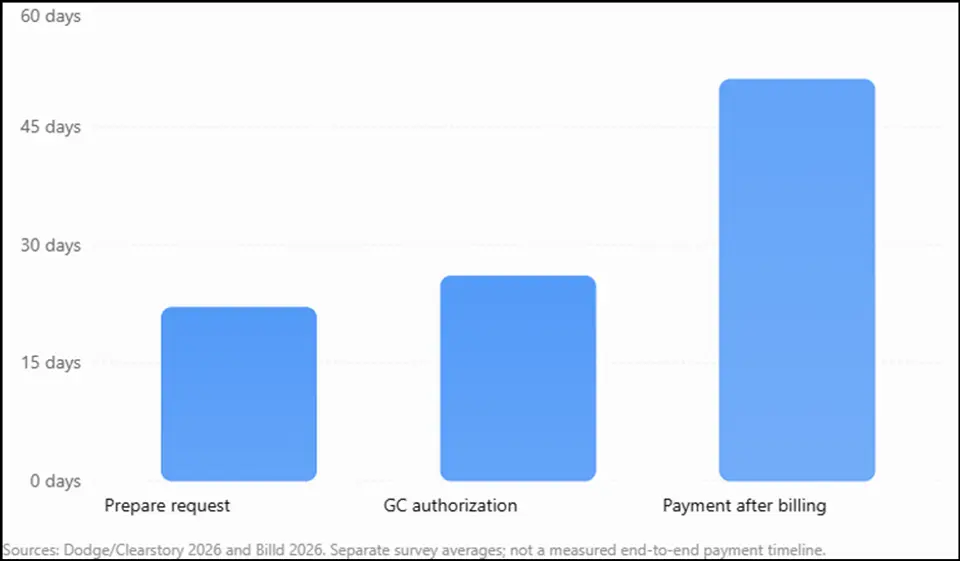
A 2026 study by Dodge Construction Network and Clearstory found that specialty contractors averaged 22 days between completing field documentation and submitting a priced change-order request.
The GC review and authorization process averaged another 26 days.
That's approximately seven weeks before the change is officially authorized.
And we're not even talking about getting paid yet.
Source: Dodge Construction Network / Clearstory
Ninety Days to Get Paid?
Here's where I think contractors need to be particularly careful.
Once the change order is approved, it still needs to make its way into a payment application. Depending on when approval happens relative to the billing cutoff, that could mean another month before the contractor can even submit it for payment.
Then there's the payment process itself.
Billd's 2026 National Subcontractor Market Report found that subcontractors waited an average of 51 days after submitting a payment application to receive payment.
Consider those numbers together.
If a contractor spends 48 days getting a change authorized and another 51 days waiting for payment, you're looking at approximately 99 days. That's an illustration using two different industry studies, not a measured average for change orders. Missing a billing cutoff could make the wait longer.
Source: Billd 2026 Market Report
During that time, the contractor has already paid its employees, suppliers, equipment expenses, and overhead.
Who financed that work?
The contractor did.
And if you're working on several projects with significant outstanding changes, those amounts add up quickly.
Not Every Change Order Is Legitimate
To be fair, general contractors and owners have legitimate reasons to question change orders.
Was the work actually outside the original contract? Is the pricing reasonable? Was the additional labor necessary? Is there documentation supporting the claimed impact?
Those are fair questions.
The Dodge/Clearstory research found disputed pricing and insufficient documentation were two common reasons GCs reduced or withheld requested change-order payments.
Contractors have a responsibility to document their work properly and submit requests promptly.
But I also think we need to acknowledge the difficulty of documenting every impact when the project team is simultaneously demanding that the work proceed immediately.
A concrete placement doesn't stop being scheduled just because the commercial team hasn't agreed on the price of a change.
And the cost of changed work isn't always limited to the additional material and labor. There's also the potential impact on productivity, sequencing, and other scheduled activities.
Those costs can be harder to substantiate, but that doesn't mean they aren't real.
A Change Order Isn't Guaranteed Profit
This brings me back to the contractor bidding a project at a low margin, expecting change orders to make up the difference.
I would be very careful with that strategy, particularly in today's data-center market.
You're assuming additional scope will develop, that you'll be entitled to compensation, that the owner and GC will agree with your pricing, and that you'll eventually collect the full amount.
That's a lot of assumptions.
You're also tying up working capital while waiting for the process to run its course.
I'm not suggesting contractors should avoid change orders. They're a necessary part of construction, and contractors should be compensated fairly for legitimate additional work.
But a project should make financial sense based on the work you're actually contracted to perform.
Any additional compensation should be evaluated on its own merits, not treated as the profit that makes an otherwise marginal bid worthwhile.
Something Worth Thinking About
There's a lot of opportunity in construction right now, particularly in data centers, advanced manufacturing, and energy.
But opportunity doesn't automatically translate into profitability.
Contractors need to understand their costs, protect their cash flow, and recognize that owners and GCs are going to scrutinize change orders.
And owners and GCs need to recognize that when they direct additional work, somebody has to finance it while the paperwork gets sorted out.
After 25 years in concrete, I've learned that getting the work is one challenge. Executing it successfully is another.
Getting paid for everything you've earned is sometimes the biggest challenge of all.

Editor-in-Chief, Concrete Logic
Seth Tandett is based in Richmond, Virginia, and has spent years working in the concrete construction industry across central and southern Virginia. His experience includes structural concrete work on multi-level frames, data centers, federal facilities, and other large-scale projects.
Today, Seth works in business development for Baker Construction and hosts the Concrete Logic Podcast, where he asks direct questions about what is really happening in the concrete industry.
Outside of work, Seth spends time studying economics, reading American history, and hunting waterfowl.
On the Concrete Logic Podcast, Seth brings the same approach he uses in the field: ask better questions, challenge weak answers, and focus on what actually matters in concrete.

If Construction Costs Are Rising, Why Aren't Contractors Making More Money?