If Construction Costs Are Rising, Why Aren't Contractors Making More Money?
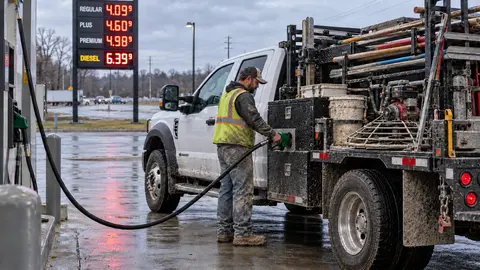
Diesel prices change daily. Your contract price? That was locked in six months ago.
Construction keeps getting more expensive. So why doesn't that automatically mean construction contractors are making more money?
Here's my argument: The companies responsible for delivering a project often have the least ability to change the price after the job is sold. Material suppliers can revise quotes. Freight companies can adjust fuel surcharges. Equipment vendors can update rates. But the contractor who signed a fixed-price agreement months earlier may have no comparable way to recover the increase.
That doesn't mean suppliers are doing anything wrong. Every business should be trying to earn a profit. It means we need to take a hard look at how construction contracts allocate risks that neither party can reliably control.
The numbers are getting harder to ignore
On October 15, Associated General Contractors of America reported that the producer price index for inputs to new nonresidential construction had increased 11.9% over the previous 12 months, through September 2026. The same release said that the index for precast concrete products was up 10.5% over that period. Associated Builders and Contractors, using a different construction-input measure, reported an 11.2% year-over-year increase and a 2.2% increase in September alone.
These are not interchangeable indexes. They cover different baskets of inputs and should not be presented as competing estimates of one identical number. But they point in the same direction: cost escalation has returned as a serious problem for contractors.
We also have a more direct comparison. AGC reported that, in June 2026, the index for inputs to new nonresidential construction had risen 7.1% from a year earlier, while the index for contractors' bid prices on new nonresidential buildings had increased only 3.5%. Those indexes are not identical in coverage, and they don't measure profit, but the gap suggests contractors had limited room to recover rising costs in their selling prices.
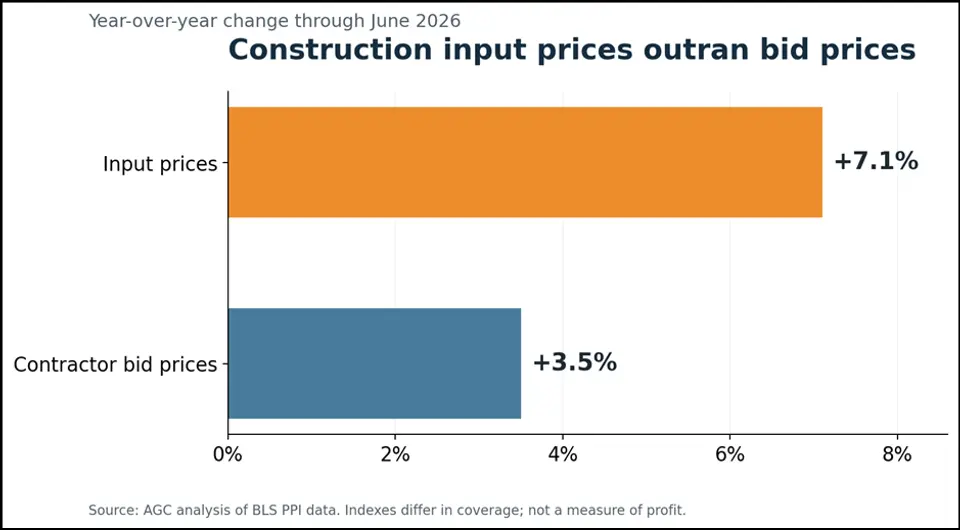
Chart 1. June 2025 to June 2026 year-over-year changes. Source: AGC analysis of U.S. Bureau of Labor Statistics Producer Price Index data. Different indexes and market coverage; neither series measures realized contractor profit.
None of this tells us how much an individual contractor earned. But it tells us why we should ask who is exposed when costs change after a project is priced.
A higher selling price isn't the same as a higher profit
There's a simple assumption that seems to follow every conversation about construction inflation. If projects cost more, contractors must be charging more. And if they're charging more, they must be making more money.
That's not how margins work.
Take a hypothetical concrete subcontract valued at $10 million. The contractor estimates $9.3 million in total costs, leaving $700,000 in projected gross profit, or a 7% gross margin. It isn't a forecast of the industry. It's just a simple example.
Now assume that a combination of concrete, reinforcing steel, fuel, formwork, and labor costs pushes the job's total cost up 4% after the contract is signed. That's $372,000 in additional cost. If the contract price doesn't move, projected gross profit falls to $328,000. The gross margin drops from 7% to 3.28%.
Costs rose 4%. Profit fell by more than half.
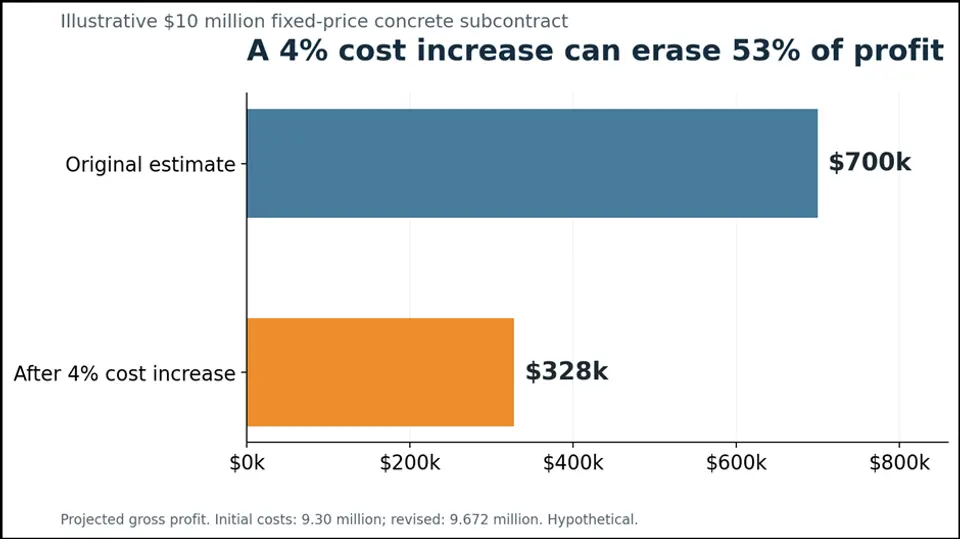
Chart 2. Illustrative $10 million fixed-price subcontract. A 4% rise in estimated cost reduces projected gross profit from $700,000 to $328,000, a 53.1% decline. Not an industry average.
This is the part that gets lost when we talk about construction inflation as though everybody's price moves up together. The owner may have approved the project budget last year. The general contractor may have committed to a guaranteed maximum price. The concrete subcontractor may have held a price for months while drawings were completed. Meanwhile, suppliers are quoting current market conditions, and some quotes are good for only a short period.
The calendar matters almost as much as the price.
Who actually has pricing power?
Construction adds a complication to normal competitive pricing: the customer may have bought the work long before the contractor has to buy materials or perform it.
Think about the sequence. A concrete contractor bids a job. The general contractor spends several months negotiating with the owner. Permits, financing, design revisions, and procurement decisions push the start date back. Eventually the concrete contractor receives a subcontract based on a price developed under very different conditions. By the time the first significant material purchase is made, the market has changed.
Who owns that difference?
Usually the answer is somewhere in the contract. But that doesn't make the allocation of risk reasonable, especially when the contractor had no control over the cause of the delay.
I'm not suggesting a ready-mix producer, cement manufacturer, reinforcing steel supplier, or trucking company should eat an increase simply to protect a contractor's margin. They're businesses too. They have employees to pay, equipment to maintain, and capital to invest. If their own costs go up, they need to respond.
The issue is that the ability to respond isn't evenly distributed through the construction supply chain. Some participants can change prices for the next delivery. Others are locked into a number established six months earlier.
The lowest bid may include the highest risk
Here's where the discussion gets uncomfortable for owners and general contractors.
If a project is awarded almost entirely on the lowest initial number, what incentive does a contractor have to include a realistic allowance for escalation? The bidder who prices that risk honestly may lose to someone who assumes nothing will change.
Then the project gets delayed. Materials go up. The schedule gets compressed to recover lost time. The same contractor who was rewarded for offering the lowest price is expected to absorb the added cost and find a way to finish faster.
We call that risk transfer. At some point, it starts looking more like wishful thinking.
There is an important distinction between the contractor's responsibility to manage normal estimating and production risks and the owner shifting an extraordinary, uncontrollable market change downstream. Contractors should own their productivity, purchasing decisions, waste, and execution. They shouldn't automatically expect reimbursement whenever they make a bad estimate.
But does a contractor truly control a major market-driven fuel spike or a project start delayed for reasons outside its scope? If not, why should the contract pretend otherwise?
What would a more honest approach look like?
Start by separating costs contractors can manage from costs they can't. If we put every increase into one bucket, we won't have a useful conversation.
Contractors can improve labor productivity, reduce waste, plan pours more efficiently, and coordinate deliveries. Those are legitimate ways to protect margins. Owners and GCs should expect that work to be done.
But material prices, energy markets, and long approval delays are different kinds of risk. There are practical ways to handle them without writing an open-ended check to a subcontractor.
For long-duration projects, contracts can use clearly defined escalation provisions tied to published indexes, with agreed thresholds, dates, documentation, and sharing arrangements. A formula can move in either direction, so the owner also benefits when the underlying cost goes down. Escalation clauses aren't a substitute for good bidding. They're a way to define what happens when the market moves beyond an agreed range.
Owners and GCs can also release critical procurement earlier when design information is sufficient. They can establish how long prices must be held and compensate for unusually long holds. They can involve concrete contractors and material suppliers while the project is still being designed, when decisions about mix requirements, sequencing, access, and schedule can actually change the cost.
Contractors also need to explain their exposure. “Everything is going up” isn't an argument. Show quantities, escalation dates, supplier quote validity, fuel exposure, and dollars at risk.
The problem isn't just the cost of concrete
Concrete contractors don't buy only concrete. They buy reinforcing steel, formwork systems, plywood, fuel, equipment, trucking, labor, and a lot of time. A project can be hurt by any one of those components, even if ready-mix prices hold steady.
Consider a project requiring 20,000 cubic yards of concrete that gets pushed back three months. The material quantity is unchanged. The price exposure isn't. If the completion date remains fixed, there's also pressure to work overtime, add crews, and accelerate formwork cycles. Those costs aren't captured by a chart of cement prices.
This is why I think we need to be careful when someone points to a construction price index and declares that contractors must be doing well. A price index tells us something about prices. It does not show who captured the increase, who paid it, or who made a profit.
The question owners should be asking
What is the cheapest way to get a project built successfully?
That's a better question than simply asking who has the lowest number today.
The answer may involve bringing the concrete contractor into the process earlier, locking in quantities and procurement windows, making sensible material substitutions, and establishing a fair mechanism for unusual escalation. It may also mean accepting that a project with a realistic price and a dependable schedule is a better deal than a low bid built on assumptions nobody believes.
None of this guarantees a contractor will make money. Nor should it. Contractors still have to compete, estimate accurately, execute efficiently, and own their mistakes. Profits are earned, not owed.
But a contract shouldn't depend on one party absorbing every major change that occurs between the bid date and the day the work gets built.
We hear a lot about how expensive construction has become. Fair enough. The numbers deserve attention. What I'd like to know is how much of that increase is actually being recovered by the companies doing the work.
If construction keeps getting more expensive, who is really getting paid more, and who is just getting squeezed?

Editor-in-Chief, Concrete Logic
Seth Tandett is based in Richmond, Virginia, and has spent years working in the concrete construction industry across central and southern Virginia. His experience includes structural concrete work on multi-level frames, data centers, federal facilities, and other large-scale projects.
Today, Seth works in business development for Baker Construction and hosts the Concrete Logic Podcast, where he asks direct questions about what is really happening in the concrete industry.
Outside of work, Seth spends time studying economics, reading American history, and hunting waterfowl.
On the Concrete Logic Podcast, Seth brings the same approach he uses in the field: ask better questions, challenge weak answers, and focus on what actually matters in concrete.
Are We Reducing Concrete's Carbon Footprint or Just Moving It Somewhere Else?