How Did America Become the World's Largest LNG Exporter?
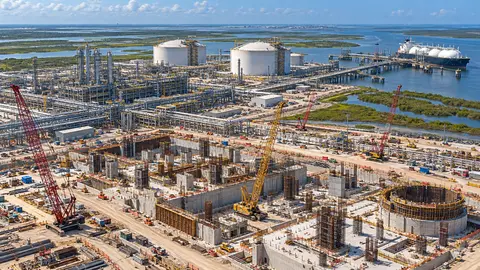
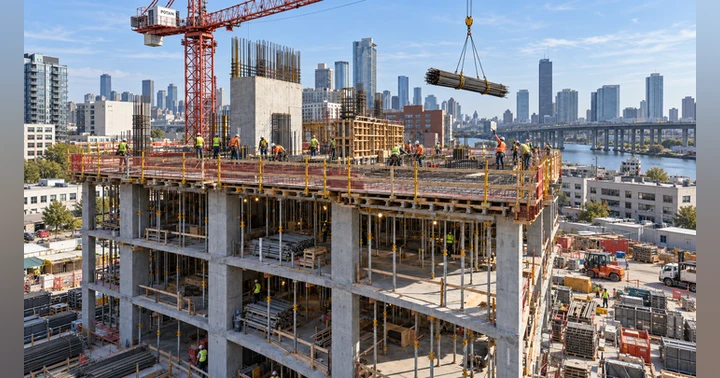
AI-generated. Actual construction still requires humans.
What if I told you that in 2008, America was building facilities to import natural gas because we were concerned about having enough of our own?
And that eight years later, we were converting some of those same facilities to export it?
Today, we're the largest exporter of liquefied natural gas (LNG) in the world.
That's quite a turnaround.
It also raises an interesting question.
How did we go from worrying about running out of natural gas to building some of the largest industrial construction projects in the country to export it?
And what does this mean for the concrete industry?
I started looking into this while preparing for EP #171 of the Concrete Logic Podcast with Joey Goscha, Vice President of Baker Construction's Gulf Coast operations.
Joey has spent decades building large industrial and energy projects, and the numbers he shared from his latest LNG project are difficult to comprehend.
But before we get into the concrete, we need to understand how this industry got here.
Remember When America Was Running Out of Natural Gas?
In the early 2000s, the outlook for American natural gas looked considerably different.
Domestic production wasn't keeping up with expectations for future demand. There were concerns about supply, particularly as electricity generation increasingly relied on natural gas.
The solution?
Import it.
Companies invested in terminals along the American coastline where LNG could arrive by ship, be converted back into gas, and enter the domestic pipeline system.
One of those facilities was Sabine Pass in Louisiana.
It opened as an LNG import terminal in 2008.
There was just one problem.
By the time it opened, the American energy industry was undergoing a transformation that would change everything.
Horizontal drilling and hydraulic fracturing were making it economical to recover tremendous quantities of natural gas trapped in shale formations.
The gas had been there all along. We just hadn't figured out how to recover enough of it economically.
Traditional drilling generally followed a vertical wellbore into a producing formation. Horizontal drilling allowed operators to turn the wellbore and travel thousands of feet through productive rock.
Hydraulic fracturing created pathways for trapped oil and gas to flow into the well.
Combine those technologies, and previously uneconomic resources suddenly became commercially viable.
Production increased. Imports became less necessary.
And those LNG import terminals?
Some were about to get a second life.
On February 24, 2016, Sabine Pass shipped its first LNG export cargo of the shale era.
The destination was Brazil.
Think about that.
A facility originally built because America needed foreign natural gas was now sending American natural gas overseas.
That's an extraordinary reversal in less than a decade.
The LNG Export Boom
The numbers tell the story.
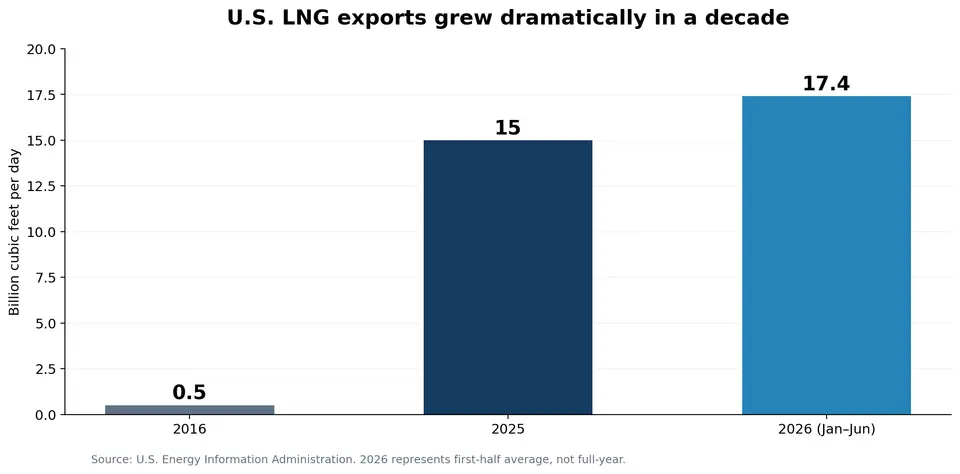
In 2016, the United States exported an average of approximately 0.5 billion cubic feet of LNG per day.
By 2025, that had grown to approximately 15 billion cubic feet per day.
During the first half of 2026, exports averaged 17.4 billion cubic feet per day.
That's roughly 35 times the daily export volume of 2016.
And more capacity is being built.
According to the U.S. Energy Information Administration (EIA), American LNG export capacity could nearly double by 2031 compared with December 2025.
Why would companies commit billions of dollars to these facilities?
Because natural gas has different values depending on where you are in the world.
The United States has enormous domestic resources, extensive pipeline infrastructure, and relatively low production costs.
Many other countries don't have those advantages.
Japan, for example, imports natural gas because it lacks the domestic resources needed to meet its demand. European countries have also increased LNG imports to diversify their energy supply.
Following Russia's invasion of Ukraine in 2022, European governments accelerated efforts to reduce their dependence on Russian pipeline gas.
That created an enormous opportunity for American exporters.
In 2021, Europe received approximately 34% of U.S. LNG exports. In 2022, that increased to 69%.
In 2025, Europe accounted for approximately 68%.
Natural gas isn't just a fuel for heating homes.
It's used to generate electricity, produce fertilizer, manufacture chemicals, and power industrial processes.
Energy availability matters to an economy.
And when countries don't have enough domestic energy, they have to get it from somewhere.
How Do You Put Natural Gas on a Ship?
This is the part that fascinated me when I started researching LNG.
Natural gas is exactly what the name suggests. It's a gas.
And shipping large volumes of gas across an ocean isn't practical in its ordinary state.
You could compress it, but transporting the quantities required by entire countries would be difficult and expensive.
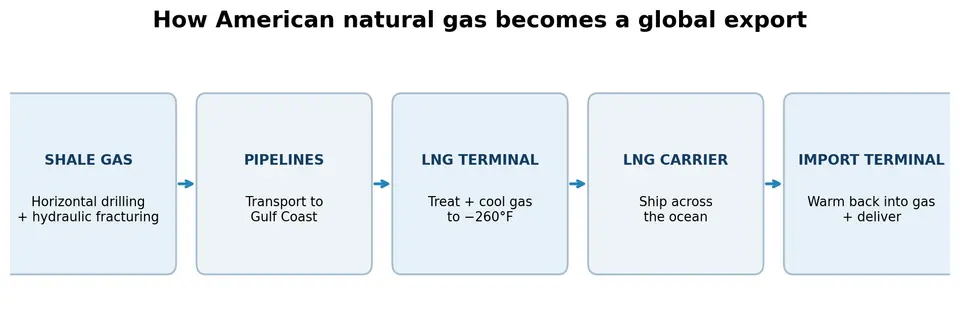
Instead, LNG facilities cool natural gas to approximately negative 260 degrees Fahrenheit.
At that temperature, the gas becomes a liquid.
Its volume decreases by approximately 600 times.
Imagine taking 600 containers of natural gas and reducing that same quantity to approximately one container.
Now you've got something you can put on a ship.
The process starts at the gas well.
Natural gas travels through pipelines to processing and export facilities, where unwanted components such as water, carbon dioxide, and other impurities are removed.
It then passes through refrigeration equipment that cools it into a liquid.
The LNG is stored in insulated tanks and loaded onto specialized vessels for transportation overseas.
Once it arrives, the process is reversed. The liquid is warmed, converted back into gas, and delivered to customers through pipelines.
Sounds pretty simple when you write it out.
But these facilities are anything but simple.
The amount of power, refrigeration, equipment, piping, and infrastructure required is incredible.
And that's before you start talking about the construction.
Why Are So Many LNG Facilities Along the Gulf Coast?
Look at where the LNG terminals are being built.
Louisiana and Texas dominate the American LNG export industry.
There's a reason for that.
The Gulf Coast already has extensive natural gas pipeline infrastructure, a large petrochemical and refining industry, access to shipping channels, and proximity to major producing regions.
It makes economic sense to build export terminals near those resources.
But there's a problem.
The ground isn't always ideal for construction.
If you've ever worked along the Gulf Coast, you know the challenges that come with soft soils, high groundwater, and poor bearing conditions.
And we're not talking about building a small warehouse.
We're talking about industrial facilities spanning hundreds or thousands of acres, supporting enormous equipment loads and complicated underground infrastructure.
This is where Joey's experience becomes particularly interesting.
What Does 585,000 Cubic Yards of Concrete Look Like?
During our conversation, Joey described a project with approximately 1,700 acres of total site area, including about 1,500 acres of active construction.
Nearly 9,000 people were working across the site.
Baker's concrete scope alone included approximately 585,000 cubic yards.
Let that number sink in.
That's enough concrete to place a six-inch-thick slab over roughly 72 acres.
And that's just one contractor's concrete scope.
Before the structural concrete work could advance, the project required extensive soil stabilization.
Joey described approximately 1.3 million tons of cement being mixed into the existing ground.
Not concrete.
Cement being incorporated into soil to improve its engineering properties.
Once the ground was prepared, the foundation work could begin.
The project involved approximately 27,000 precast concrete piles, each around 80 feet long and 16 inches square.
Joey explained that the piles were imported from Turkey, arriving by ship in enormous quantities.
Just coordinating their delivery, unloading, transportation, and installation became a substantial construction operation.
And then there were the foundations.
Individual concrete placements ranged from several hundred cubic yards to more than 4,000 cubic yards.
The team was targeting 10,000 to 12,000 cubic yards of concrete placement per week.
To support that schedule, the site used four batch plants rated at 250 cubic yards per hour each, plus two standby plants.
Nine different concrete mix designs had to be coordinated.
A remarkable amount of work.
But perhaps the most interesting part wasn't the volume.
It was the precision.
What Happens When a Massive Module Doesn't Fit?
Joey described how portions of LNG facilities are fabricated overseas and shipped to the construction site as enormous modules.
Rather than building everything piece by piece in the field, large sections of processing equipment arrive substantially assembled.
Those modules then have to be transported to prepared foundations and lowered into position.
Imagine building a massive concrete foundation months before the equipment arrives.
Now imagine that equipment traveling halfway around the world, arriving at the job site, and being lowered onto a series of anchor bolts.
It either fits or it doesn't.
Joey said his team had successfully installed 14 of 14 modules at the time of recording.
That's impressive.
But what caught my attention was something else he said.
Much of their success came from decisions made before construction started.
Specifically, the test pile program.
He explained how properly evaluating pile performance and selecting the right foundation systems helped avoid expensive problems during construction.
On a previous project, his team experienced significantly higher foundation costs and labor requirements associated with a different pile system.
On the more recent project, he estimated savings of more than 30% in comparable foundation costs and man-hours.
Think about the implications.
A project involving hundreds of thousands of cubic yards of concrete can save enormous amounts of money by spending more time and effort making the right decisions before construction begins.
We've discussed this repeatedly on the Concrete Logic Podcast.
Construction productivity isn't always improved by asking crews to work faster.
Sometimes it starts by giving them a better plan.
Is Exporting Natural Gas Always Good for America?
There is another side to this story.
Natural gas exports create economic opportunities for producers, construction companies, equipment manufacturers, ports, and communities.
But exports also create additional demand for American natural gas.
And additional demand can influence domestic prices.
The EIA has studied this relationship. Generally, greater LNG exports increase demand for domestic production and can place upward pressure on U.S. natural gas prices, all else being equal.
That matters to American manufacturers, electric utilities, and households.
There are environmental considerations, too.
Natural gas production and transportation can release methane, a potent greenhouse gas. LNG liquefaction consumes substantial energy, and large coastal facilities can affect surrounding communities and ecosystems.
Those issues deserve consideration alongside the economic benefits.
The challenge is determining how to balance domestic affordability, environmental performance, international demand, and the opportunity to develop American energy resources.
That's a serious discussion worth having.
But whatever your position on LNG exports, one thing is difficult to dispute.
The infrastructure being built is substantial.
Are We Entering Another Golden Age of American Construction?
Toward the end of our conversation, Joey said something that stayed with me.
He believes we're experiencing another golden age of American construction.
I think there's a reasonable argument for that.
Look at the industrial projects happening across the country.
LNG export terminals. Semiconductor manufacturing facilities. Data centers. Energy infrastructure. Advanced manufacturing.
Some of these projects are larger and more complicated than anything most commercial contractors will encounter during their careers.
Yet we continually hear that America doesn't build anything anymore.
Maybe we're looking in the wrong places.
These projects aren't always visible from the interstate. They don't necessarily make the evening news. And owners aren't always interested in sharing everything happening behind the construction fence.
But the work is happening.
And the concrete industry is a major part of it.
There's another lesson here for contractors and suppliers.
Industries change.
Ten years ago, few people could have predicted the exact scale of America's LNG export business today.
Twenty years ago, many investors were preparing for a future in which America needed to import more natural gas.
Then technology changed the economics.
The investment followed.
Construction followed the investment.
And now we're pouring hundreds of thousands of cubic yards of concrete into infrastructure that barely existed a decade ago.
Which makes me wonder what we're overlooking today.
Are we preparing ourselves for the next generation of American industrial construction, or are we too busy chasing the same projects we've always chased?
That's a question worth thinking about.
If you haven't listened to EP #171 of the Concrete Logic Podcast, 585,000 Yards of Concrete: Building a Massive LNG Plant, I encourage you to check it out.
Joey Goscha gives us a rare look at the scale, planning, and construction challenges behind one of America's fastest-growing energy industries.

Editor-in-Chief, Concrete Logic
Seth Tandett is based in Richmond, Virginia, and has spent years working in the concrete construction industry across central and southern Virginia. His experience includes structural concrete work on multi-level frames, data centers, federal facilities, and other large-scale projects.
Today, Seth works in business development for Baker Construction and hosts the Concrete Logic Podcast, where he asks direct questions about what is really happening in the concrete industry.
Outside of work, Seth spends time studying economics, reading American history, and hunting waterfowl.
On the Concrete Logic Podcast, Seth brings the same approach he uses in the field: ask better questions, challenge weak answers, and focus on what actually matters in concrete.
Why Are We Asking Concrete Crews to Fix a Productivity Problem They Didn’t Create?