
 Podverse
 Fountain
 Spotify
 YouTube
 Apple Podcasts
 Castro
 RSS Feed
 EP #171: 585,000 Yards of Concrete: Building a Massive LNG Plant
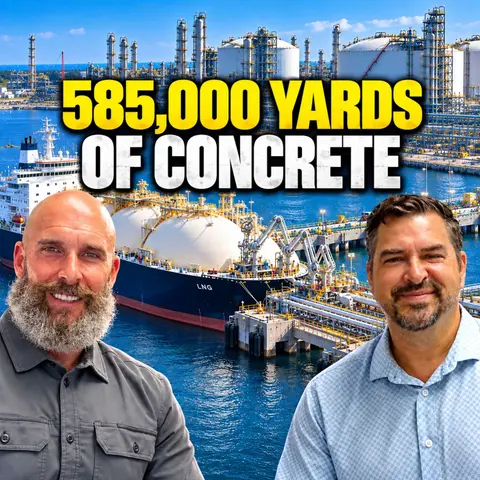
What does it take to build the process area of a massive LNG facility?
Seth talks with Joey Goscha of Baker Construction about the concrete work behind the liquefaction trains, power facilities, and underground systems. Joey explains why the job starts with the ground and why early decisions can affect everything that follows. Seth presses him on pile connections and what happens when the work in the field does not go as planned. They also discuss how crews manage concrete production, safety, and quality at a pace few commercial contractors ever see.
WHAT YOU’LL LEARN
- What the process area includes beyond the LNG storage tanks
- Why Gulf Coast ground conditions shape the work from the start
- How precast piles support massive equipment foundations
- Why Joey believes owners should invest in a thorough test pile program
- What can happen when pile connection sleeves miss their intended elevation
- How foundations are prepared for modules built elsewhere and shipped to the site
- Why crews place much of the structural concrete at night
- How multiple batch plants supply different mixes across the site
- Where precast and cast-in-place duct banks each make sense
- Why Joey puts safety first when discussing schedule and productivity
- What would surprise a commercial contractor walking onto an LNG project
(01:45) Introduction and ways to support the show
(04:26) What is LNG, and why does it matter?
(08:41) What goes into an LNG process area?
(10:53) The size of the site and its workforce
(12:13) Ground stabilization, piles, and foundations
(17:12) Pile connections and the case for test piles
(20:52) Night pours and concrete production
(24:25) Miles of duct banks, piping, and trenches
(27:04) Safety and productivity at this scale
(29:28) Why stabilizing the ground is harder than it looks
(33:00) What would shock a commercial contractor?
(35:11) Joey on the pace of American construction
GUEST INFO
Joseph “Joey” Goscha
Vice President, Baker Construction
Guest link: https://www.concretelogicpodcast.com/guests/joseph-goscha/
CONCRETE LOGIC ACADEMY
Ground conditions, pile decisions, mix coordination, and placement all affect what happens next. The more you understand the “why” behind the concrete, the better questions you can ask before problems reach the field.
Concrete Logic Academy offers practical concrete education and courses for people who want to build that knowledge.
Start learning here:
https://concreteschool.co
SUPPORT THE PODCAST
If the Concrete Logic Podcast gives you value, share this episode with a colleague.
Have a topic or guest suggestion? Use Ask Seth or leave a voicemail at:
https://www.concretelogicpodcast.com/
You can also visit the website and click Donate to send some value back:
https://www.concretelogicpodcast.com/donate
GET THE CONCRETE LOGIC NEWSLETTER
One email each week with the latest episode, a new article, and questions worth asking about the concrete industry.
Sign up here: https://www.concretelogicpodcast.com/concrete-logic-newsletter-sign-up/
10% OFF KUIU FOR CONCRETE LOGIC PODCAST LISTENERS
Need gear for your next hunt? Shop KUIU through our link and use code LOGICPOD for 10% off: https://www.concretelogicpodcast.com/kuiu
CREDITS
Producers: Jodi Tandett and Concrete Logic Media
Music by: Mike Dunton
https://www.instagram.com/mduntonmusic
WHERE TO FIND SETH
Concrete Logic Podcast:
https://www.concretelogicpodcast.com/
YouTube:
https://www.youtube.com/@concretelogicpodcast
LinkedIn:
https://www.linkedin.com/in/seth-tandett/
Concrete Logic Academy:
https://concreteschool.co
Until next time, let’s keep it concrete.
01:45 - Introduction and ways to support the show
04:26 - What is LNG, and why does it matter?
08:41 - What goes into an LNG process area?
10:53 - The size of the site and its workforce
12:13 - Ground stabilization, piles, and foundations
17:12 - Pile connections and the case for test piles
20:52 - Night pours and concrete production
24:25 - Miles of duct banks, piping, and trenches
27:04 - Safety and productivity at this scale
29:28 - Why stabilizing the ground is harder than it looks
33:00 - What would shock a commercial contractor?
35:11 - Joey on the pace of American construction GUEST INFO Joseph “Joey” Goscha Vice President, Baker…
Seth (01:45)And welcome to another episode of the Concrete Logic Podcast. And today we're going to talk about what it takes to build a process area for a massive LNG facility. We're talking deep foundations, huge equipment pads, miles of piping, tight tolerances, large crews, and a concrete operation that has to stay ahead of everything else happening on site. And we're going to see what that actually takes.my guest today is Joey Gosha. He's vice president of Up Baker Gulf Coast. Joey started in construction in 1995 as a laborer and worked his way through the civil crafts surveying superintendent, construction management, project management, and eventually major project leadership. Over the course of his career, he has helped lead large industrial and energy projects, including billion-dollar scale work. so heHe's going to explain to us what it takes to put together a big LNG construction project. But before we get started, I just want to remind everyone how you can support the show. And the first thing you can do is share it with a colleague or co-worker. So if you enjoy the show, please share it. Next thing you can do is if you go to concrete logicpodcast.com, there's a couple ways to get a hold of me in the top.Navigation bar, there is a menu selection. It says ask Seth. If you click on that, an email form pops up. And what I'm looking for you from you is a topic or guest suggestion. So reach out and and tell me what who you want to hear from, what you want to learn about, and we'll make sure we'll get that on the show. if you prefer to send me a voicemail, there's a way to do that as well. On that on the website in the bottom right-hand corner, there's a microphone. You click on that.And you can record a message right on your phone or your laptop and leave me a message again looking for topic or guest suggestions. the next way you can help us out is you can donate to the show. and again on the on the web website on the home page of concrete logic podcast dot com, there's a donate button. You click on that, it's a big blue button, can't miss it.Click on that and PayPal page pops up, and you can give any amount that you feel the podcast gives you in value. so we appreciate that. And also, if you want to check out concreteschool.co, that is also a way to expand your concrete knowledge by joining the concrete logic academy. All right.that's all my promos for today. Let's get back into LNG. Joey, welcome to the show. Thank you for coming on the show. beJoey Goscha (04:26)Yeah.Seth (04:26)all right, yeah. before we get into the the nuts and bolts, I guess first of all, can we explain what LNG is and why an average person should care about what LNG is?Joey Goscha (04:37)Yeah, so it's becoming probably our our greatest export project a product here in the States and used to be we would just a lot of times we would off gas this prod product and not use it at all in the oil and gas world and anyway someone way smarter than me discovered if you cool it to negative two hundred and sixty degreesit it actually shrinks six hundred times in volume and you can go through this incredible process, put it on some ships and I guess ship it over to those less fortunate around the world that that that need the gas. you'll notice most often, almost always, the the facilities, the export facilities, the liquefication facilities areclose proximity to the Gulf. And what that means in in South Louisiana, Texas, Mississippi, where I've spent most of my time, means that you're gonna get some really crummy soils. And you know if if you go about a hundred miles east of the Mississippi River, you start getting into some pretty low cows where people would actually lay out on a beach. And if you go about four hundred miles west ofof the Mississippi River you'll get back into some pretty locations where people would actually lay out on a beach. But if you sit right in that five hundred mile radius of the Mississippi River, hundred east, four hundred west, you'll find a tremendous amount of L and G projects. there's really no development down along our coastline, very little if SoAnd it's because the Mississippi really keeps it just so muddy and messy and and just it's not pretty. And so it's a great spot to put some things that produce gas for the rest of the world. And that's that's kind of the world we live in, right?Seth (06:25)Yeah, so I had to study a lot for this interview because I I didn't know a whole lot about the the industry. So my understanding is a a lot of this it's coming from when they from like eastern Texas, and in Louisiana, they're piping natural gas from those areas where they're what w what what's the drilling type that they use out there?Joey Goscha (06:47)Cracking. Yeah. It's coming out of the shell. Yeah, coming out of theSeth (06:48)fracking, that's right. So that's where they Yeah. SoJoey Goscha (06:52)shell.Seth (06:53)so they drill really far down and then kinda go laterally into the into the shell and pull the gas out. It's it'sJoey Goscha (07:00)Yeah. Yeah.Seth (07:02)incredible technology. I can't believe somebody figured this this thisJoey Goscha (07:06)Yeah.Seth (07:06)out. So I was reading about this, I was like, Holy crud, this is this is amazing technology.Joey Goscha (07:12)Again,yeah, th and and you know, there's a lot of that too south that goes out towards the the gulf, out into the gulf and they'll they'll they'll they'll get into those shells out there as well. So there's a lot of pipeline on the bottom of the gulf and then there's obviously to your point there's a lot of pipelines coming from Texas, Louisiana and and Mississippi justJust an abundance of natural gas here and so it's a wonderful product. obviously we all get the benefit of it here in the United States, very cheap natural gas prices that basically power most of our power plants, but Europe's out of gas and much of Asia is as well. So someone the same smart person that figured out the fracking technique probablyhelp figure out the freezing and and putting it in these massive ships and sending it off to people in dire need of it that are willing to pay a good bit for it. So it's a real industry and it's been a part of my life now for the past eight years. Eight years ago I was really upset with L and G because I had one of my last chemical projects going and these thingsrequired a tremendous amount of manpower and resources and suddenly people were leaving my job site to go to an L and G and I I I I did curse it a little bit, you know, what the heck is this all about? And now here I am eight years later, completely blessed, with an abundance of opportunities in in the L and G space.Seth (08:41)Yeah, so let's let's get into that. So my understanding as your your team builds the process area at the L and G facilities, what exactly does that include?Joey Goscha (08:53)Yeah, so that would include your kind of there's I guess four components. Usually a lot of them are three components, as far as process goes, but this one has another piece that we're on right now, so I'll speak about each one of those. But we have the liquefaction trains, which is where they're gonna you know, bring the the the gas down to the temperature, and then of course the pre treatment area, which is where they're gonnatreat the gas, clean it up a little bit. And then you've got your power blocks because they need so much power to run this. They build their own power. It's called Power Island. And then so they'll they'll build their own power turbines. and then in this one, this facility is unique 'cause it has an SRU that I'm happening to be working on right now. And so they can do even more. They can take less attractive gas and get the sulfur out of it and actually producesuper high end product at the end like like all others that but most plants require a pretty clean gas to come in. but once you add that SRU piece to it, you can take some dirtier gases and and still get that great end product that everybody wants. So those are the I guess the the four main areas and I I would I'd be remiss to not say that you know there is another section of this but I've never builtthe tanks, but I I definitely want to that to be known that that you know the guys that do build those tanks they'd be pretty upset with me if I didn't at least give a shout out and say, hey, this is incredible what they do. They they have a steel line tank with the concrete around it. That obviously that's where the material gets stored at negative two hundred and sixty degrees in a liquid form. And you know, I wish I knew more about that piece of it.I hear that's where the real money's at, but of course I'm over in the process area slugging it out. But yeah.Seth (10:38)Yeah.Well, we know who to reach out to. We'll we'll get that gentleman on the show hopefully and he can explain the tanks.Joey Goscha (10:46)yeah.Seth (10:47)But that's what I thought of when you first said that's what you work on. I mean that's what you see when you you think of those facilitiesJoey Goscha (10:52)yeah.Seth (10:53)as big L and G tanks. So let's just talk about the scale of of these projects. Can you give us a sense of how big the sites are, how many folksJoey Goscha (11:01)Mm.Seth (11:02)are working on these sites?Joey Goscha (11:04)Yeah, so scale wise it's incredible. The particular site most recent on is seventeen hundred acres. with fifteen hundred of those acres truly being built upon. You know, you've gotta have some retentions and stuff in those other couple of hundred acres, but it's about fifteen hundred acres of of actual construction areas andTeam wise, we we're sitting at three thousand right now, with the group that I have the put you know the privilege of leading, but the overall manpower on the site is almost nine thousand and that does include your mechanical crafts, some of your support folks, and then some of your electrical big presents for electrical and these things, as we get into like some of the deeper scale ofyou know, scopes, you'll you'll hear some numbers that'll just boggle your mind, with regards to how many linear footage of duck banks for instance are on this project. it's just crazy. So but yeah, it's a good number. Fifteen hundred acres building on and nine to twelve thousand craft at any any given time.Seth (12:13)Yeah. It's like a small city going on with the amount of people and the thousands of acres that you you guys are working at. yeah, so let's walk through the concrete scope. What kind of kinds of piles, pile caps, equipment, foundations, pipe racks. Assume there's some slabs, underground structures as well.Joey Goscha (12:33)Yeah, so our scope on this particular project is around five hundred and eighty five thousand cubic yards of of concrete. But I kinda like to back up just a little bit and talk about the formation of the project. this is gonna be a little unique to to people that are used to working on really nice, beautiful clay earth. So we started this project with one pointmillion tons of cement that we cut into the earth and and this all kind of leads to the formation of the project. So you you cut 1.3 million tons of cement and then you start digging up the site. It's kind of funny but that's that's what happens. You till it in it's all bucket mixed. Few areas that'll actually be drilled mixed but most of it's bucket mixed. It's 1.3 milliontons of cement and the next thing that we're gonna see is our pilings. the piles for the most recent job were pre-cast concrete piles and they were actually imported by the owner from Turkey and these were eighty foot sixteen inch square piles that they would bring on what I'd call super ships about five or six thousand at a time.company by the name of OnSite would bring those, they would offload them at the MOF, and then they would put these on Go Hoffers and 15 piles at a time would show up in each one of the driving rigs to kind of give that a little scale. we drove 27,000 piles on the job site to date and a little under a year. so just think about the logistical challenge ofYou know, just getting those piles to those rigs and and just cutting in one point three million tons of cement and and that's just to get started, right? And so then we drive the piles after we've we we typically start off in a bathtub with our piling. So we'll cut down three to four feet. we call that a bathtub in our world. We drive the piles, try and hit those piles as close to grade as possible.plus or minus three inches and remarkably this job did really well because it did a pretty extensive test pile program and so we were able to get those piles in that plus or minus three inch range and then you you're gonna go and pour a seal slab and the next thing you're gonna do is you're gonna come with a bunch of uplifts into those piles. Most of them do require attention.so that's where your uplifts come into play and and obviously you naturally got the compression and the lateral loads that are sitting just on the resting on the pile. And once we once we get to that point we we'll form up our foundations and then these pores range anywhere from four to five hundred yards.Upwards of 4,000 yards in the liquefaction area. The liquefaction SRU have the larger pores. And to put it in scale, we're we're trying to hit around ten to twelve thousand cubic yards a week of installed concrete. And our average pounds per cubic yard, it's large bars, so we're we're getting upwards of 220 to th two hundred and fifty pounds.of of rebar per cubic yard. And it just it's super labor intensive and it's it becomes very repetitive because the way these blocks are set up. They're liquefaction blocks and they're just one after another. And you're setting the table with everything that I'm talking about right now to to inevitably bring in these pre built massive modules fromall over the world. This is my favorite part, like the part that really fascinates me coming from a bit of a survey background. But we'll we'll load a a city. It would look like a city to most people and it'll come off of a ship from halfway around the world and they'll transport it over to our foundations that we've prepared. And it's it's like it either fits or it doesn't.Seth (16:35)Right.Joey Goscha (16:36)Youknow, and it gets dropped down on the anchor bolts and really I I guess it's very exciting. It's almost like game day, you know. You've practiced, you've done all this prep for it and now it's time to set it. So far, I think we're fourteen for fourteen on this particular project. So it's been really good. They've all sat down nice and easy and and the design that's being provided in this you know, thisparticular project is quite good. the the engineer of record really knew how to give some I guess some grace to our capabilities. So they're making us look really good and it's it's been a great project.Seth (17:12)Yeah. What going back to the piles, y you were saying the uplift piles, those are the ones that have dewy dag that stick out of. So after youJoey Goscha (17:19)Do be dead. I don't know.Seth (17:21)dri drive those piles, is that something you put in afterwards? Is that how those work?Joey Goscha (17:25)Yeah.Yeah, so those piles are pre-sleeved, thirty six inches.Seth (17:30)huh.Joey Goscha (17:31)some of them are single single sleeve and some of them we see in our industry are four sleeve. But they're they're pre they're they're pre-slotted, you know, it's embedded into the pile when they pre-cast those piles and then we we drop those those embeds in and that that gets an epoxy grout that grouts that into place.And it's there for the tension. And there there are some piles out there south that don't require that. Some of your bigger structures that don't carry any wind load. we we don't put the up with most of we weSeth (18:05)Yeah, you kind of just skimmed right past that important part of doing the test piles. I can tell you I've been on a job where they either screwed up the test piles or they I don't know, something got messed up. So those sleeves, right, w are put at a certain depth. AndJoey Goscha (18:22)Yeah.Seth (18:23)what happened was the piles couldn't be driven down far enough for us to use those sleeves and we had to have s someone come out and cord drill all thoseholes for those slaves. It was a mess.Joey Goscha (18:37)can improve one thing in the industry. I kind of talked to you a little bit about this yesterday offline, but I'll mention it again today. If I could do if Joey Gosher was king for a day and they said what would you do? I would tell every owner, every customer invest in a test pile program. To to your point, you know those those sleeves are quite cheap when you just slip them in and you cast them in a precast pile. That's very cheap.But cutting off four extra feet of pile, losing all of your of your embedment, and now having a core drill that thirty-six inch thirty-six inch deep embedment into a precast pile that's probably eight thousand, nine thousand PSI concrete. That is that is the most disappointing and it it will just kill a project. So just imagine what I described when I'mStarted, you know, we've poured 270,000 yards of structural concrete in under a year on 27,000 piles. You you'll never get there. You'll never have that type of success. You'll never have the pace that we're having with without that component right there. I I I you know, the project I did before this one, they used a different pile type.pour in very similar structures and and we're saving thirty percent plus cost and man hours compared, you know, if you just compare apples to apples, the two projects, and it was it was really it came down to a pile selection and and how you connect to that pile. So it's it's incredibly important if if more owners watch this podcast and they say, you know whatListen to this guy. He's he might know something. Thirty two years of I've been disappointed I've been on the right side of it and I've been on the wrong side of it. And I I tell you your project's gonna suffer immensely if you're on the wrong side of of of files, not knowing, you know, exactly what you need with that test file program.Seth (20:36)Yeah. I think the th that's a very important point is taking more time up front saves you more time in the long run when you're actually out there and that the time counts, right? Yeah.Joey Goscha (20:47)Yeah. Yeah it'syou're giving away you're giving away a silver bullet right there, for sure.Seth (20:52)No.well let's talk more w not just about the concrete. The the the volume of concrete is in incredible. So is are on that a job like that, are you running twenty four seven to keep that pace?Joey Goscha (21:03)Yeah.Yeah. So when I said we had three thousand people on site, it's two thousand during the days and a thousand at night. In the Gulf region, you know, we from July until the end of September we don't see a day below ninety degrees during the the the the the peak of the day. So what we do is we we primarilywork on putting together our pores during the daytime and then we're we're pouring at night. The only pores we're really making during the day are seal slabs and things that support form work. all your structural material pretty much comes in at night and II did a little r of my own research before the program because I lost count at some point in this job. But I we have a total of nine different mix designs on a job that has four two hundred and fifty cubic yard per hour batch plants with two standbys. And so when you're dealing with that many mixed designs and you're trying to just time everything out perfect for you've got a four thousand yard pour going on over here and it seems likeWell, that's super easy. Everything's at the exact same spot, but you know, drivers wanna go. Dri concrete truck drivers are special and they like to go where they think they are supposed to go and and so y it's a tremendous exercise to make sure we get all those mixed designs exactly where they're supposed to go and there's a coloring system on all the trucks. That's what we found is the easiest. AndSeth (22:33)Yeah.Joey Goscha (22:33)so when you show up, if you don't have the right color to what's on the back of the pump truck towhat's on the back of your concrete truck, those two can't go together. They have to have to go find the right color poor. So yeah. But it's it's tough with that many mixed designs andSeth (22:46)Yeah. That's a good idea. Yeah.Joey Goscha (22:50)everything right there central located on one job site gives to be a little bitSeth (22:53)Well.Joey Goscha (22:54)channel.Seth (22:55)How many batch plants?Joey Goscha (22:56)What's that? So we have four,Seth (22:57)How many batch plants do you are? Okay.Joey Goscha (23:01)two hundred and fifty cubic yard per hour on site and then we have two standbys. And people often say, Well what what what are the two standbys for? Well, when you're in the middle of one of those pores and like I say you have multiple large mass pores going one's got one particular mix and another one's got another mix, you can't mix those two things up. So you the standbys if if two of thebatch plants go down, they're supporting one poor, one of them goes down, they'll quickly engage a a standby plant there to to pick that up. So that's the thought and the the logic behind it all and that's taken a lot of planning and teamwork and and and everybody sharing and resources and whatnot because there are multiple civil contractors on the site that areyou know, different agendas and different things that they need to get done and different schedules and time frames. So it's big coordination effort for sure. And the company doing that, for the job site is on site. they bring all of their cement in and super sacks is pretty unique. same same people that you know cast all the precast piles, they bring all the precast piles there as well. SoBut they've had a tough job, very tough job. I would not want and I wouldn't want to be the person responsible for keeping up with that much concrete daily, for sure.Seth (24:25)Yeah. well let's talk about I think we started talking about but l piping. What kind of piping is involved? in duck and duck bank as well.Joey Goscha (24:32)Yeah. Yeah.Yeah. So in the L and G world with it being modules, they don't like to put a lot of the electrical up, you know, in racks like we would traditionally see in the refinery world or the petrochemical world. We see a lot of racks and that's where your electrical most of it travels, but in the in the L and G world because everything's modules.They want to put all the electrical and as much rack as they can below grade. And same thing with their as much pipe as they can. So we talk about duck banks on this job in miles. And total miles that we'll our group will put in is almost 17 miles. of that 17 miles, about 11 of it is precast. there's a company called Ready Duck.that makes these pre-cast duck banks. They come in a an array of configurations and it it's been a really good solution for a lot of things. But then we have some really deep areas where we have to get super deep and and it just ends up not making sense, you know, it becomes too big or maybe the duck banks just become too large that there's no way. So eleven miles of it is the the ready duck, the precast stuff.and then another six miles of cast in place dug and and then the the the pipe we've got up to 84 inch hdp on this job i mean that looks like it looks like you know small tunnel flying in the sky when you see one of those eighty foot lengths of eighty four inch and that's for a big storm water that goes around the outer perimeter of the facility.But in total, we're somewhere in the twenty eight thousand linear feet of HTP right now. And we're about six thousand feet in the carbon steel. And then one one other really cool thing that that thatalong the Gulf is instead of trying to build all these trenches, you know, that are required for some drainage and what various what not, that all comes in precast f to our projects. And I I you know, I've tried to write down a lot of the numbers and dig out a few of the numbers to be ready for the podcast today. I I can just tell you it's miles of trenches. I don't know exactly how many.But it's it's miles and miles and miles of trenches. So yeah, we talk about underground pipe and miles, duck banks and miles and precast trenches. We talk about those in miles as well.Seth (27:04)Wow. Yeah, that's incredible. so everything that we've gone through, right, it all sounds like risk to me. So so if you had to pick the biggest risk on the job like this, what would you say it is? Is it, you know, schedule, safety, quality?Joey Goscha (27:19)Yeah, I thinkit's I I I think when we talk about risk, that you know, safety has to sit at the the the forefront of that. So we've worked we've worked w when we finished this job we've worked almost eight million man hours. Right now we're at about five point six million. And our T R. I R is down in the point15.17 range and and that doesn't happen by accident. That happens in a collaborative effort where the owner really supports the safety program, the engineer of record really designs to support safety, and then the the the training and the the work that's been put in by the craft and and and the supervisors.that that all adds into to that safety performance. But it's it's always our number one risk when we're talking about ninety plus degrees every day and we're trying to put twelve thousand cubic yards of concrete in a week. We we have to be on top of our game, you know a good good man that you and I both know he always talks about SS QP and I I th there's a lot of truth to it. You know, if your safety startsslipping and failing and your schedule's gonna fail and schedule fails and your quality's gonna fail and if if all three of those go away well productivity's out the window then and if any one of those is not in its right tier level, you know, it just they all go together and so I I would say safety's our biggest risk just because we really truly try and take care of the people and and thenIt's a race because every day that they're not making gas or putting gas on a boat and sending that to Europe and Asia, we're we're really losing money and and we want to be a good partner to anyone that we're building these facilities for. And so you know productivity is vitally important and it's not the most important thing. I've never heard anybody say that from any of the owners that we work for, butProductivity is vital and important and the sooner they can put gas to to their clients then the better off they are as well. It really is up toSeth (29:28)So here's one for you. What is one part of the building an L and G process facility that looks simple on a drawing but becomes extremely difficult in the field?Joey Goscha (29:38)Mixing making cement into dirt. It looksSeth (29:42)Ha ha ha.Joey Goscha (29:44)I mean if you just took a cut section of a drawing and it justSeth (29:47)Uh-huh.Joey Goscha (29:48)says, you know, five feet of cement stabilized material. That that sounds great, all right. But then when I say, well, you know, you're starting off on a a marsh that's really not good for anything to to to build on it.you get some some type of a bottom in it. Well, you gotta just slowly start making your way. And so what we typically do is we try and get all of our permanent roads in some form or fashion Obviously we've got to do a lot of SWIP work out before we get that done, which is your stormwater prevention planning.Seth (30:25)Right.Joey Goscha (30:25)But the number one thing that I would say people people look atAnd they just go, yeah, well we're just gonna go out there and mix one point three million tons of of cement into this ground and we're gonna have a perfect perfect solution. The mixing the one point three million tons of cement into the dirt is quite a challenge and it's it's always it's always more difficult than you've initially expected.Seth (30:52)And does it need to sit for a certain amount of time too to or how's that work?Joey Goscha (30:56)Yeah,they they've you know I I say sometimes Seth that we have fuzzy math and construction. There's a fewSeth (31:04)Uh-huh.Joey Goscha (31:04)things that are fuzzy math for me, like rock rock pile piers, you know, these are rock piles, I think they call geo piers. And another one that's a fuzzy math for me is is how long does it take the cement to make the earth good again?Seth (31:20)Uh-huh.Joey Goscha (31:20)I've I've you know itThere is a science to it and it is an engineered calculation, but when you mix them with a bucket and it's not just as it's it's not a it's not as perfect as your money. There's a art to it and depending upon which operator actually mixed that material, you can start seeing some set times in three you know, three to four hours sometimes and then you can get and you're looking at something in a real man that's beenin the next for about three to four weeks now it's still just pretty sloppy so it's it's not as scientific as we would like, but I would say if it was if everything was perfect then yes, in about three to four days you should be able to start working on that material and not worry about sinking down to your neck andSeth (32:07)Yeah. Huh. Yeah, I would imagine just like make when you're making concrete that you know it's all dependent on what it's interacting with. So I could imagine over a wide space like that the soil types changeJoey Goscha (32:23)There we go.Seth (32:24)and that probably affects the the cement. Yeah. Yeah.Joey Goscha (32:26)yeah. Yeah. Yeah,you get into some sand pockets and stuff. You we know. I mean, driving piles in in the Gulf region you can get you can get some variation, pretty pretty significant variation in soil types on a fifteen hundred acre site for sure. Same thing with like to your point, cutting the cement. They can get pretty large variations butrecognizing it and understanding it th there's some true professionals that do that and I I I always admire those operators that I see that just have it down to a science. It's hardSeth (33:00)All right. normally we talk about commercial jobs on this podcast for the most part. We stick with that. If someone that's done, you know, like myself, commercial projects for most of their career, what what would be w one thing that would shock a commercial contractor when they walk on a L and G site?Joey Goscha (33:21)You know, I I I've I've been on quite a few commercial sites and and I think the if I had to say the biggest difference I think it's the the size of everything, you know, the number eleven rebars where I think a lot of commercial places we don't see many number elevens for sure. and and just the overall pace.And it's different, right? Because commercial you hear, wow, commercial they build so much more efficient and cheaper and industrial is expensive. And that that's true in in a lot of ways, but I think I think a lot of it's the size, just the sheer size of things. I mean, we've got fifty two two hundred ton cranes supporting us in in five areas. and then we've gotseventeen two hundred ton plus driving rigs, you know, in in all of these different areas. So I I I think it's pace, but it's a different it's a different feel, right? Yeah, because when you're going up with a building, you're kinda doing a a building and then you're repeating your floors. Well, with this, you're you're doing a lot of the same things, but you're not going up, you're going horizontal. And I I think it's thatThat's probably the biggest difference. Just the footprint of it would surprise people and the pace of it. and then the size of of all the widgets and gadgets. I mean, it's nothing for us to see a three and a half inch by forty-eight inch anchor bolt with a twelve pound flat plate on the bottom. I mean, you're only setting that bolt with a with a fifty ton rough terrain crane, you know, there's no picking this thing up where it'swhy the bolts and stuff on the commercial side are quite quite a bit smaller than that. So that would be my answer, but I'm sureSeth (35:06)Yeah.Joey Goscha (35:06)somebody much smarter than me could have something greater difference than that.Seth (35:11)Yeah. Well, I just I'm shocked by the scale. I know I don't think a lot of people understand the size of some of these projects that are going on in the US right now. you know, I'd people, you know, say we don't build anything of scale anymore in the USand I think that's just 'cause a lot of these projects, like the one you're on, there's not a lot of public information about what we're building 'cause they're all, you know, theytrying to keep quiet. but the scale of some of these projects, especially ones that b Baker on are just incredible.Joey Goscha (35:46)The I I've been in construction since nineteen ninety five, as you said, as a laborer. And and back when I started in nineteen ninety five, it's just a quick fun little story, Milliken Carpet had burnt down and Fleur had the project and they saidWhen I got done with the project I worked on it for about a year. They said you need to forget everything you just saw. And I said, What what in the world? Why would I need to forget everything I just saw? And they said, You'll never see anything built this fast again and and what what it was, the the plant burned down in ninety four, we rebuilt it in ninety five and the Olympic Games were coming to Atlanta, Georgia in ninety six and they had all of thethe fabrics and the carpets and anything that pertained to the Olympics and they wanted to sell all of these products. And so then ninety six I get sent to Sherman, Texas, and we're building the first silicone wafer facility. And we're in a race floor with Brown and Root Kellogg Brown and Root is building the same thing in Arizona. And so the first two years of my career, I I guess I was just unlucky. I drew like a bad straw, butI was on the two fastest built facilities since World War Two back to back. And I think back to those times and I say, Wow, we did some incredible things back in ninety five, ninety six. What's being done in this L and G space right now, what I'm witnessing, is better than that. The technology's better. the equipment that we have to support us is better. And you know, everybody loves to say, Well, the craft the craft aren't as good. WellWe got some pretty darn good craftsmen too. And andSeth (37:23)Yeah.Joey Goscha (37:23)I I think back I was one of the craftsmen. I really wasn't that great. Maybe I was a bad pick, but you know, the the people, the effort that I see people putting forth and the pride what you just spoke of, America's in a golden age again of building stuff. And we're building some incredible stuff. The L and G facilities are incredible.I've had the privilege of going on a few of the data center jobs. I get to see a few different components. We're just in a real golden age of building an American. It's so exciting to a guy like me that's on the back half of his career. I'm certainly not on the front half anymore, but I think we're building some incredible stuff and I think we're doing it with just the the greatest hearts and intentions. It's when you know when we get paired up with the right owners and the right leadership.Many things by the script.Seth (38:14)Yeah. Well I think that's a perfect stop for today. Joey, I appreciate you coming on the show. I don't know if weJoey Goscha (38:21)Yeah.Seth (38:22)gave the the what you guys are doing, if we it we just started touching on the points and probably didn't get to the full appreciation of the the project that you're on, but I appreciate you sharing what you can.Joey Goscha (38:36)Yeah.Seth (38:38)All right, folks, until next time, let's keep it concrete.

Vice President Baker Construction
Started in construction in 1995 as a laborer for Fluor.
Worked through the civil crafts for several years and was promoted to party Chief in 1998. Continued in Survey role for 4 additional years moving from Fluor to Cajun in 2000. In 2002 I was promoted to superintendent. In 2004 I was promoted to a Construction Manager. In 2006 I moved to a site manager. 2007 I was promoted to a PM. In 2009 a senior PM. In 2010 a project director overseeing the capital project at Chevron Pascagoula until 2013. In 2014 I was the director of the Sasol project my first billion-dollar project to oversee. In 2019 I left Cajun and was the founder of Baker Gulf Coast Industrial. We wrote the business plan in early 2019 and started the company in May of 2019. I now serve as the Vice President of BGCI, and we are building our second LNG ISBL facility. The current contract sits at 1.7 billion dollars.