
 Podverse

 Fountain

 Spotify

 YouTube

 Apple Podcasts

 Castro

 RSS Feed
EP #174: Is Poor Planning Killing Concrete Productivity?
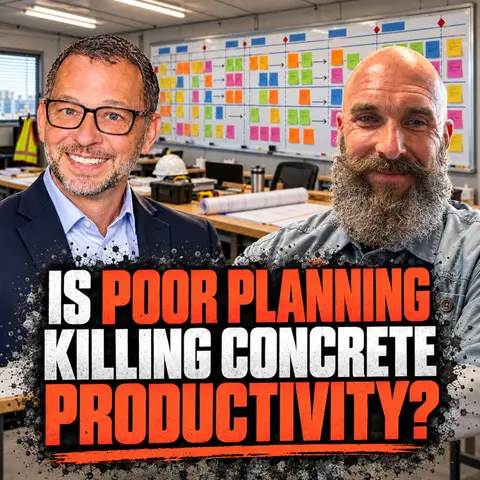
ON THIS EPISODE OF THE CONCRETE LOGIC PODCAST
Is construction's productivity problem really the crews, or the plan they're being asked to follow?
Recorded at the Lean Construction Institute Congress in Atlanta, Seth talks with Daniel Megason, Vice President at Baker Construction, about how Lean construction can improve planning, coordination, and productivity.
Daniel explains the Last Planner System, why getting field crews involved matters, and how better communication between trades can prevent costly delays.
But does Lean construction actually solve problems, or does it just create more meetings?
WHAT YOU'LL LEARN
- What is Lean construction, and why should concrete contractors care?
- How does the Last Planner System differ from traditional construction scheduling?
- Why does Daniel believe culture is the biggest obstacle to implementing Lean?
- How can advanced work packaging connect long-term planning with daily field execution?
- Why should foremen and craftspeople help develop the schedule?
- What does Lean look like when preparing for a concrete placement?
- How can concrete, electrical, plumbing, and other trades coordinate their work?
- What happens when weather, material delays, or production problems disrupt the plan?
- Does Lean construction actually reduce wasted time, or does it just mean more meetings?
- Why do megaprojects require a different approach to planning and execution?
- How can contractors move from reacting to problems toward eliminating constraints before work begins?
(01:43) Are We Asking Crews to Fix a Planning Problem?
(04:59) What Is Lean Construction, and Why Does It Matter?
(06:43) Advanced Work Packaging and the Last Planner System
(08:16) The Biggest Challenge With Lean: Changing the Culture
(09:00) Getting Foremen Involved in Daily Planning
(10:29) How Lean Fits Into Baker Construction's Approach
(11:51) Planning Concrete Work Around the Other Trades
(12:59) What Happens When the Plan Falls Apart?
(15:30) What Does Collaboration Actually Look Like?
(16:28) Does Lean Just Mean More Meetings?
(17:30) Why Megaprojects Require a Different Approach
(18:30) Moving From Reacting to Problems to Predictable Execution
GUEST INFO
Daniel Megason
Vice President, Baker Construction
Guest profile:
https://www.concretelogicpodcast.com/guests/daniel-megason/
LEAN CONSTRUCTION RESOURCES
This episode was recorded at the 2026 Lean Construction Institute Congress in Atlanta, Georgia.
Special thanks to the Lean Construction Institute (LCI) for allowing us to use its recording space at Congress.
Lean Construction Institute:
https://leanconstruction.org/
LCI Congress:
https://congress.leanconstruction.org/
Construction Industry Institute (CII) | Advanced Work Packaging:
https://www.construction-institute.org/awp-overview
CONCRETE LOGIC ACADEMY
Why do we keep asking crews to solve problems that could have been addressed before construction started?
Concrete Logic Academy is built around helping concrete professionals understand not just what to do, but why it matters. From concrete materials and construction methods to the decisions that affect quality, productivity, and schedule, the goal is practical education you can put to work.
Get free access to Concrete Logic Academy while it's available:
https://concreteschool.co
SUPPORT THE PODCAST
If you're getting value from these conversations, here are a few ways to help keep them going.
Share the podcast. Send an episode to a coworker, colleague, or someone in the construction industry who could benefit from it.
Suggest a topic or guest. Visit the podcast website and click "Ask Seth." What do you want to learn about? Who would you like to hear from?
https://www.concretelogicpodcast.com/
Donate to the podcast. If the show is providing value, consider sending some value back. Contributions help keep independent concrete education available.
https://www.concretelogicpodcast.com/support/
Interested in sponsoring the podcast or working with Concrete Logic Media?
Email Seth: seth@concretelogicpodcast.com
KUIU LISTENER OFFER
Seth has partnered with KUIU to offer Concrete Logic Podcast listeners 10% off their next order.
Use discount code: LOGICPOD
Shop KUIU and support the podcast: https://www.concretelogicpodcast.com/kuiu
CREDITS
Producers: Jodi Tandett and Concrete Logic Media
Music by: Mike Dunton
Special thanks to the Lean Construction Institute for providing the recording space at the 2026 LCI Congress.
WHERE TO FIND SETH
Concrete Logic Podcast:
https://www.concretelogicpodcast.com/
YouTube:
https://www.youtube.com/@concretelogicpodcast
LinkedIn:
https://www.linkedin.com/in/seth-tandett/
Concrete Logic Academy:
https://concreteschool.co
Until next time, let's keep it concrete.
[00:01:43] Seth: Welcome to another episode of the Concrete Logic Podcast. What if the biggest problem with construction product-productivity isn't the people doing the work, but how we're planning the work in the first place? Think about it. How much time do we waste waiting on materials, dealing with changes, working around other trades, or trying to make up a schedule that wasn't realistic to begin with?[00:02:06] We talk a lot about improving productivity in construction, but are we actually fixing the problem or just asking our crews to work harder? today, you might notice if you're watching on YouTube, I am joined today with Daniel Megison, vice president of Baker Construction, and we're in Atlanta. What the kids say, Hotlanta, right?[00:02:29] Hotlanta. Hotlanta. we're at the LCI Congress, Lean Construction Institute, and, Daniel is a, he's experienced with Lean Construction. He's gonna introduce it to us today, so we're gonna learn some basics, and, talk why, why there's... How many people are at this thing, you think? sixteen, seventeen hundred.[00:02:50] Wow. Somewhere along in there. Yeah. So people from all around the world, all the companies you can think of, I've seen. but we're, recording this episode right before the actual kickoff here. But before we get started, I just wanna remind everyone how you can support the show. The first thing you do is if you enjoy the show or not enjoy the show, you can share with a colleague or a coworker.[00:03:15] You could say, "Hey, this Seth guy doesn't know crap," and make all kinds of fun of me. That's fine, too, but share it. the second thing you can do, if you go to concretelogicpodcast.com, on the homepage, there's a couple ways to get ahold of me. at the top of the page, there's a little navigation bar, and one of the options says Ask Seth.[00:03:36] If you click on that, an email form pops up, and you can fill it out and it's an email to me. And what I'm looking for is topic or guest suggestions. Who do you wanna hear on the podcast? What you wanna learn about? Tell me, so I put out episodes you actually wanna watch and listen to. the next way you can, help out the show is donate.[00:03:59] I did this on my own, and I wanted to do it to get education out to folks, 'cause I know not all of us can, like today, travel to conferences and have the means to do that. So I wanted to make sure we put out concrete education for the folks that wanna put it out there. So you can donate. That's on the homepage as well.[00:04:18] There's a big blue button that says Donate. and actually, today I got something... We were talking about this earlier. You like Kuiu, don't you? I do. I got-- I worked up a thing with Kuiu and got us all a discount code. So if you shop Kuiu or wanted to shop Kuiu, I got you 10% off. Use the, I think it's a discount code.[00:04:39] I don't know how it is on there, but you can pu-put in a code, and it's LOGICPOD, L-O-G-I-C-P-O-D, and I'll get you 10% off your next, order at Kuiu. Is that my surprise? Thank you. Yeah. Yeah. I'm gonna use it. There I'll use it when we get out of here. There you go. I'm glad. let's get into this, topic at hand.[00:04:59] What is lean construction, and why is it so important?[00:05:02] Daniel Megason: Oh my goodness. Let me start off first by saying thank you for all you do for the concrete world, not only for the concrete world, but construction industry on a whole. I'm Daniel Maggison. I've been in the construction industry for about 30 years, in the heavy industrial side for about 25 years.[00:05:17] I spent almost 20 years working international, building mega capital projects. and lean construction is near and dear to my heart. projects are becoming larger, they're more complex, they're more schedule driven, and at the same time, labor and resources are constrained. We can't continue just relying on the old practices.[00:05:35] We need to start using technology and some of these new approaches that, that helps us, that helps us how we plan, how we coordinate, and how we execute the work.[00:05:45] Seth: Yeah. Yeah, complicated like, I released it last week on... this one will come out a little bit later, but the episode I did with Joey Goscha with Baker Construction.[00:05:53] That project we talked about, can't disclose what it where it is or what it is, but it was big. Yeah. We're talking thousands of people. Baker themselves had 2,000 people working during the day and 1,000 at night. I might have got that backwards. Yeah. But two, two... Close to 3,000 people.[00:06:10] People, yeah. Maybe a little bit over 3,000. yeah. So you gotta plan for that city of folks that you're managing.[00:06:17] Daniel Megason: And mind you- And mind you, that's 3,000 civil concrete workers. And piling guys and gals. that, that doesn't account to all the other trades. That just puts why LCI and the Last Planner System, along with, advanced work packaging under Construction Industry Institute, so important that we need to use to be able to plan and actually be able to predict, solely predict where we're gonna be.[00:06:39] Seth: Yeah. [00:06:39] Daniel Megason: When we're gonna be there. Yeah. So tell us a little bit more about that. Construction [00:06:43] Industry Institute, it has advanced work packaging. it starts in the home office, where you get construction involved with engineering, and it helps to build the packages from a from a construction perspective going into detailed design.[00:06:55] And then when you get into the field, Last Planner System is, to me, is a real good bolt-on to our 1,200 to 2,000 hour work packages, and it gets us down into that last week or, and day by day execution. It's something that, the why lean is really important, LCI and Last Planner System's really important to me, is that it allows, it allows us to take a schedule, what, and see what the schedule says, what it says we're supposed to do.[00:07:23] It allows us to be able to see in front of us to see what work fronts are actually available and open to work. but more importantly, it gets the, the worker, the foreman and the crews engaged into, committing to executing that work. And that's, and I think that's what the glorious thing is about, the Last Planner System.[00:07:41] is there some magic to the number of hours? You said, 1,500 to 2,000. Is there's a magic there? it comes and goes. It comes and goes. advanced work packaging started in Canada. on a, it's, it was a two-week rotation. So you'd build a work package, a work face planning or an IWP based on two weeks of work.[00:07:58] Because when two weeks, I would get there today, and then two weeks from today I'd leave, and then the next crew would come in. I was expected to get that work done in that nominal amount of hours. So there's a clean break between the crews. There's a clean break. That's right. Yeah. When I left, I've finished my job and a new work package is handed over to you to, to start.[00:08:16] Seth: That makes sense. So what's the biggest challenge with implementing Lean?[00:08:22] Daniel Megason: Ooh, that's a tough question, but it's a easy answer. The biggest challenge is cultural. you have to move from telling people what to do, toward involving them in the planning and getting them engaged early to where they're buying into it.[00:08:36] The craftsman that's actually doing the work, if they don't buy into a plan, it could be the best plan in the world you and I put together, but if they don't buy into it, very seldom do we make it. and it's getting their buy-in and it's that opening up that collaboration, between the office and the field and and between the trades.[00:08:53] Seth: So [00:08:53] Daniel Megason: how do you do that? Like, how do you get that buy-in? what are some things out in the field where you know it's working? with [00:09:00] the last planner system, we're, you bring your foremen, your crews in, or your foremen, in on the, the, in the morning time. You sit down, you go through the plan of the day.[00:09:09] these are the activities that I'm gonna get knocked out today." And then at the end of the day, you bring back in and it's like, "Okay, this is what we got. We was able to get a little bit extra here. Maybe we didn't get so much there." And so that just resets the plan going into the next day.[00:09:22] Seth: Yeah. [00:09:24] The, what about when you're, you were talking about that these plans don't actually exist on the, just the computer, right?[00:09:32] So how do you get, the field to kinda see what you guys are working? is there a, t- like, when they meet in the morning, is it o- a board or something or-[00:09:42] Daniel Megason: So when we meet in the morning, when you meet in the mornings, it's, it can either be showcase, showcasing a model- or going through, a sticky board.[00:09:50] looking at the activities of what we've got today and being able to go through each line item activity- one by one. So it's breaking it down from a CWP into, instead of a level three to, a level four, level five schedule- day to day. But it's having a work board and having a plan, a clear plan that your entire team sees.[00:10:08] I've been on some jobs, in the Middle East and in Asia, in Eastern Europe, we'd have boards out in the field that the craftsmen, not only the, the superintendents and the foremen, general foremen could see, but actually the craftsmen, they could see what our targets were that we had to hit- [00:10:23] for the week- Yeah ... to be able to make production and schedule.[00:10:27] Seth: Cool. [00:10:29] let's see. How does Lean tie into Baker's approach to construction?[00:10:32] Daniel Megason: Ah, [00:10:32] that's the important question. There you go. We believe success, successful construction starts with the first concrete placement. it's well before the first concrete placement rather.[00:10:41] And, when business development, pre-constructions, operations, when we get our customers together and we sit around, and we start engaging early, to where we can put a plan together, then that allows us to identify the risk. it improves our constructability, and it creates more predictability around execution.[00:10:58] And that, that's very much aligned with the Lean principles of what we're going through this week. Yeah. What-- Can you give me an example of how it would work? if we're getting ready for a concrete pour, how would you implement Lean? So when you're, if you're getting ready for It's not-- If you're saying I'm getting ready for a concrete pour- two weeks from now. I'm prepping everything. I'm going through, we've gotta have, okay, we've got X many hours allotted for, site grading. You gotta have a, X many hours allotted for rebar placement, X many hours allotted for, our form work, and being able to sequentially, put all that together.[00:11:33] But then that's where we're engaging the foremen's, and the crafts, with our plan, letting them be able to see, okay, "Daniel, we can't do that. We can't do that. We're not gonna be able to do that, and this is why." Or, "Hey, we may can be able to do this a different way and be able to get more production out of it, and it's safer and it's faster."[00:11:51] Yeah. so that's for like internally, like for us as a concrete contractor that's getting the buy-in for our group. So how do you get the... 'Cause like the, like you're pouring a concrete slab, you got all the other trades. And my, our friends, in the MEP trades, we always, barking at them to hurry up, get their conduit in, get their things in so we can pour some concrete, right?[00:12:19] Seth: Yeah. [00:12:19] Daniel Megason: So how do you, how, what does that look like when you're using Lean? How do so the [00:12:25] last planner system, depending on all the There's so many platforms out there that you can actually use, to implement, the last planner system. But at, at the end of the day, we are one piece of the pie, so one piece of the logic that fits into it.[00:12:39] and it's that collaboration, it's that daily huddle plan. It's not just with our team in the concrete world, but you bring in your electricians, you're bringing in your plumbers, you're bringing in your steel guys. and that's, and it's all part of the last planner system. it's about the collaboration and how we do it all together.[00:12:55] Seth: Does that make sense or did, or do I need to try a different way? let's [00:12:59] talk about when things don't go right. you put this fantastic plan together and something happens, weather happens, production, lack of production happens. So what would we do different if we take a lean construction approach versus A traditional, I guess traditional, for lack of better words approach.[00:13:18] Old school approach.[00:13:19] Daniel Megason: You're, [00:13:20] old school is old school. Yeah. Old school is always, it's tried and true. It's, just lean is just adding an extra step to it. But- Yeah ... when we have the variables that we have to deal with, whether it be the weather or, it could be material in today's world.[00:13:33] Yeah. Or it could be, one of the other trades that's in the way. that's, when we have to sit down, if we're truly running a, a collaborative system on a job site, and I'm, and from an owner's perspective, now this is more of an owner's comment- ... or GC, EPC comment. if we're running a collaborative job site instead of just segregating or, and/or siloing trades, making sure that we're all talking amongst one another, we're able to overcome a lot of those obstacles.[00:13:59] Yes, the weather's gonna hit us. we've got jobs in Louisiana right now. They seem like, we couldn't get any rain in Texas, and rain just camped out in Louisiana. but it, and we had to account for that. and that being said, we had to, it, you, we have to work around, you're always having to find a, that extra workaround.[00:14:16] But I don't think I answered your question. I think I went off on a tangent there for just a little bit.[00:14:20] Seth: No, [00:14:20] Daniel Megason: keep going. You're good. Yeah. but [00:14:22] it's truly the collaboration piece, that the Last Planner System brings in. Because it's got, it's, and because it's not me and you, us sitting in a office or even the construction manager that's making the plan.[00:14:35] We're bringing, we're engaging the the craftsman- or the craftsperson into the plan. and, they see things. They're doing things a little bit different. They're swinging tools. they're the ones that's working, that's actually getting the job done in the field.[00:14:47] Getting them engaged, in part of the lean practices is getting that buy-in, and you're bringing that in. And sometimes things just don't go right in the, in, even in our world, in the concrete world. we may be get a bad batch of concrete, and- Yeah ... by golly, we have to take it out.[00:15:02] But, and that's, and that, some of those things is, most everything's preventable, but then there's some things that's not. And what do you do when it's not? It's going back to the basics. All right, so we have to tear something out, or we have to redo something, or if we have to suck that water out of the hole because, it flooded us, on us over the weekend.[00:15:17] it's just, that's going back, but then again, it goes back to that, the one thing that I was, I'll harp on the most is, and that's that collaboration amongst not only internally, but amongst the other trades. I Your trade partners.[00:15:29] Seth: Yeah, [00:15:30] so when you say collaboration, do, what do you mean by that?[00:15:35] Daniel Megason: The [00:15:35] collaboration that, that openness and transparency, that- ... that open communication that I'm having, that superintendents are having with one another, whether it be with Baker and, one of the electrical trades or one of the plumbing trades. It's about... And then at the same time is what we're seeing more and more clients are actually starting to, now they're shaping themselves in more of a, a lean process where we're having daily, a daily SIMOPs meeting, whether that be in the morning or whether that be in the afternoon.[00:16:02] But that's all the tradespeople coming in, the superintendents and above to talk about the week's plan, talk about the day's plan, talk about the, the issues that they're having. "Okay, I'm not gonna be able to meet what I said I was going to because of this." And so it allows the other folks then to plan around that to where we can still do work and open work fronts where we can't, where we where we were originally planned to work.[00:16:26] Does that make sense?[00:16:27] Seth: Yeah. [00:16:28] Daniel Megason: If, someone's listening to this and they're like, "Man, this just sounds like more meetings" What would you say to that? it's not. it is, but it's not. Yeah. It's, it's, at the end of the day, it's, that working harder or working smarter, being able to...[00:16:41] The biggest problem that we have in construction, it doesn't matter where you're at, is that lack of communication- and transparency. and the more that you and a MEP contractor, y'all aren't competitors. and it's advantageous for you to be working with him- helping him to get his work done faster, more efficiently. The same thing with us. as soon as he gets his stuff in the ground, then we can come in right behind him for placement. yes, it does require, it requires some discipline- ... more than it requires, time.[00:17:11] Seth: Yeah, [00:17:11] and working together- Yeah ... versus against each other. I think that was a great point. So if this doesn't sound like something, like if someone's listening to this and they're like, "Man, that just sounds like just a whole lot of work I don't wanna deal with," then they're probably not, ideal for some of these larger projects like Baker does, right?[00:17:30] [00:17:30] Daniel Megason: Some [00:17:31] people will agree with this comment and some people won't. I've been on some of the largest jobs in the world. th- you can get away with managing a smaller project- ... differently than you can a mega project. when you're starting to talk about a billion, $2 billion plus, $50 billion job, they have to be managed in a different way than your couple hundred thousand or, $2 million jobs.[00:17:53] No. It's just... and it takes that disciplined approach to planning, and it's not... and if you're not careful, if we don't collaborate, it we become silos, and I'm out here trying to reach my own targets, and I can't get my targets because you can't get a conduit out of my way. or, the other company, X, can't get its plumbing out of the way.[00:18:10] And, you've got to pull wire, and then it's... you got to have that collaboration as on these bigger projects. Yeah. They're... it's... The projects like what we're experiencing today are not like the projects we had 20 years ago. Yeah. It's just different. Yeah. A $300 million job back then is a $4.5 billion job now.[00:18:28] Seth: Yeah. [00:18:30] if you wanted to leave everybody with something today, what would you wanna leave them with? As in regards to Lean, not the Dallas Cowboys or Texas Rangers. [00:18:39] Daniel Megason: Hey, [00:18:40] come on now. Come on. America's teams got Lean. for me, Lean construction and the Last Planner Systems are really about changing how we approach project delivery.[00:18:48] It's moving away from reacting to problems in the field and towards anticipating and eliminating constraints before they, they reach execution. at Baker, we understand the importance of bringing the right people together early, from pre-construction through field operations. Ultimately, when we improve our collaboration and planning So if that's my, if you're gonna leave me one last- remark to make, that would be it. everything goes back to, collaboration, predictability, and execution. And when we talk about, the last planner system, and we talk about daily planning, that is allowing us to be, being able to be predictive, and being able to truly where we're gonna be.[00:19:26] and that in essence, that's what defines success, when we do what we say we're gonna do.[00:19:32] Seth: Yeah. [00:19:33] All right. I think that's a good place to leave today. Daniel, thank you for coming on the show. Thank you. And I'll, put, links to, Lean Construction Institute in the Congress. Thank... I'd like to thank them for letting us use their, their booth.[00:19:47] That was nice of them. We all, we look professional and, like we know what we're doing, and people are walking looking at us weird, but hey, Taking pictures too. Taking pictures, taking video. It's kinda weird. But anyways-[00:20:01] Daniel Megason: Seth, [00:20:01] I'd like to thank you again. Yeah. Thank you for what you do.[00:20:04] Thank you for allowing me some time with you. next time it's in a, in more informal session, but, I do. I thank you for what you do for the industry.[00:20:11] Seth: I appreciate that. Thank you very much. And folks, until next time, let's keep it concrete.