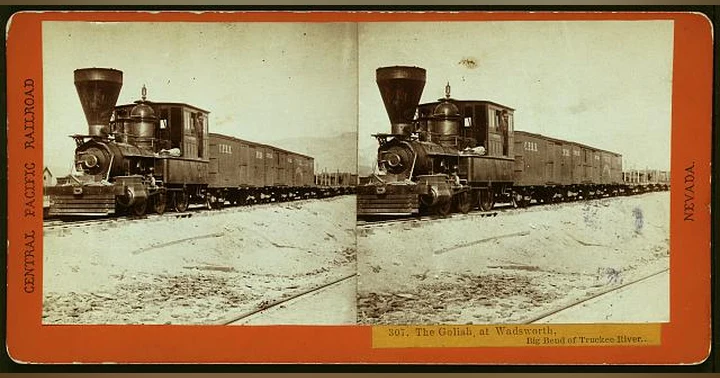
America’s Long Experiment With Tariffs
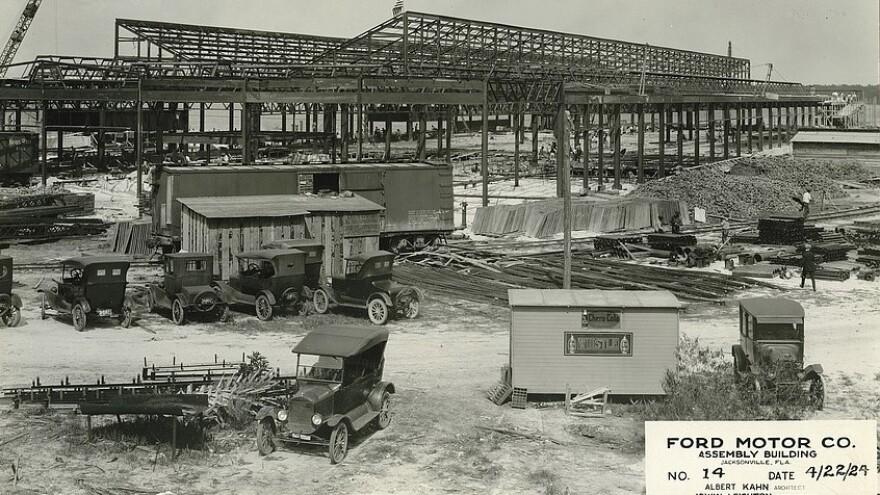
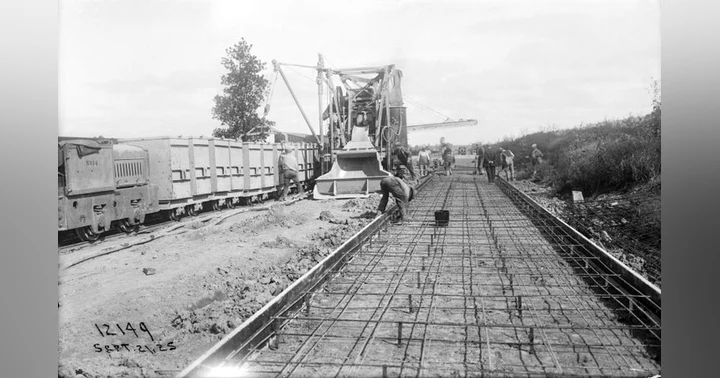
Before ‘American manufacturing’ came with a charging cable. | Albert Kahn Associates 1924.
What happens when America puts up a wall around its economy?
We actually ran something close to that experiment for several decades.
Beginning in the late 1800s, the United States maintained some of the highest protective tariffs in its history. The McKinley Tariff arrived in 1890. The Dingley Tariff followed in 1897. Tariffs came down in 1913, went back up in 1922, and reached another extreme with Smoot-Hawley in 1930.
During those same years, the United States transformed from a growing agricultural nation into one of the most powerful industrial economies on earth.
Factories multiplied.
Cities grew.
Exports soared.
American companies became global giants.
And eventually the system crashed into the Great Depression.
So was this tariff era good for the average American?
The answer is more complicated than either side of today's tariff debate would probably like.
America in 1890
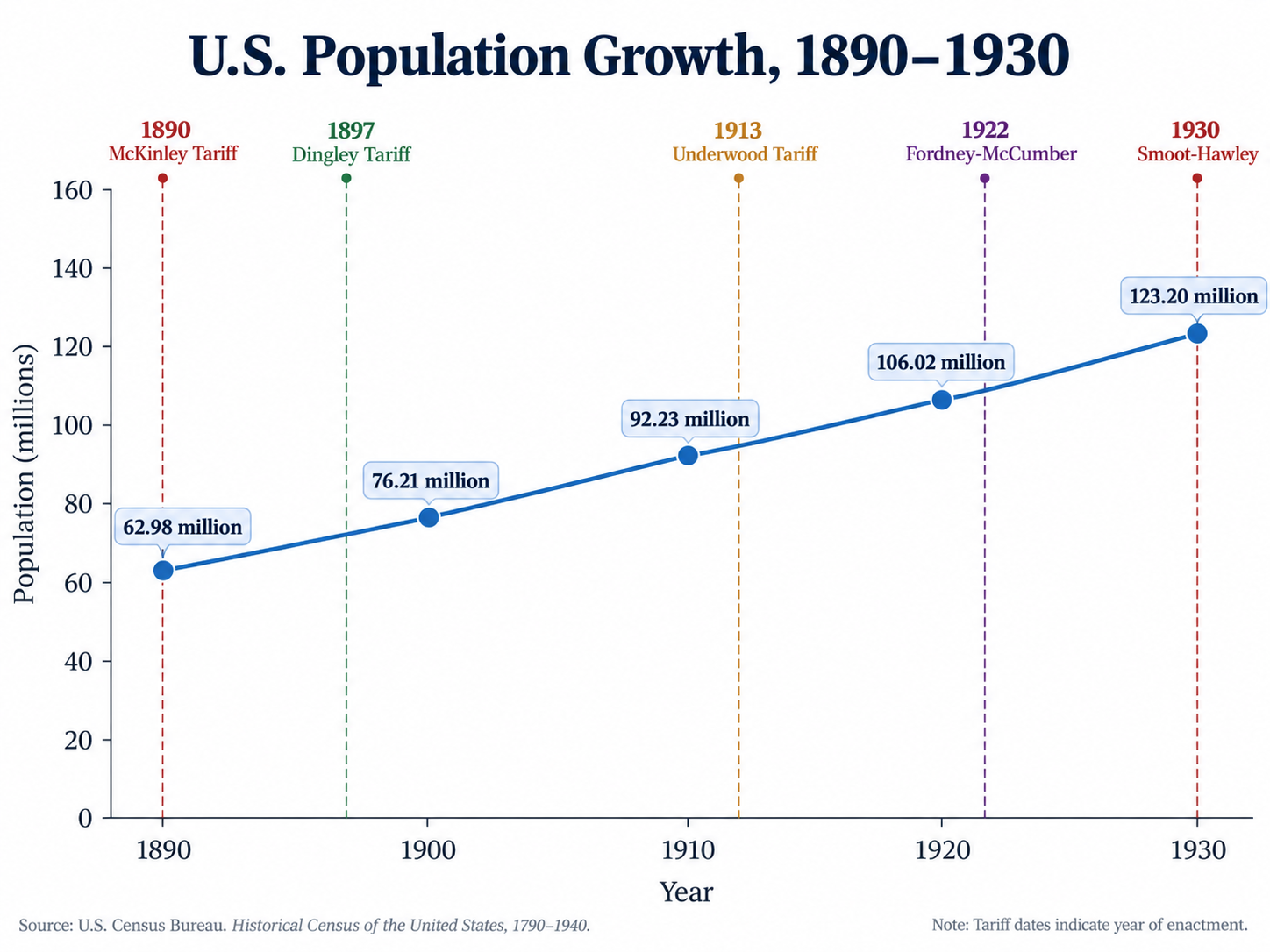
In 1890, the United States had about 63 million people. By 1930, the population had reached roughly 123 million.
America nearly doubled in population.
At the same time, millions moved toward cities and industrial centers.
New York grew from about 1.5 million residents in 1890 to nearly 7 million by 1930. Chicago went from about 1.1 million to more than 3.3 million. Detroit exploded with the automobile industry.
This was not a stagnant economy hiding behind a tariff wall.
It was an economy changing at incredible speed.
The Government Ran on Tariffs
There was another major difference between that America and ours.
There was no modern federal income tax when William McKinley became president.
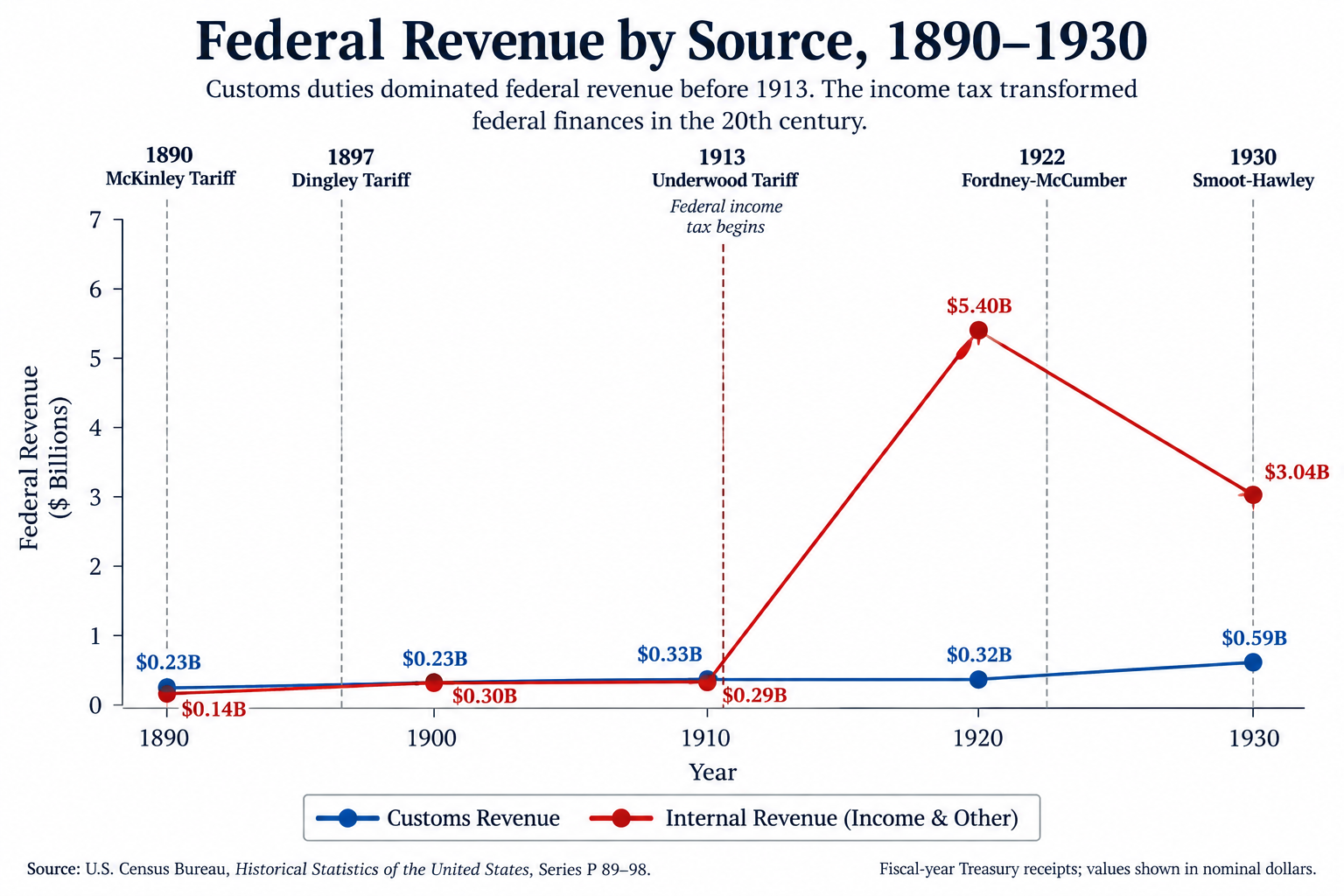
For much of the 19th century, customs duties were one of the federal government's primary sources of revenue. The government collected money when imported goods entered the country.
Tariffs therefore served two purposes.
They protected American producers.
And they funded Washington.
That changed after the 16th Amendment and federal income tax arrived in 1913.
As income-tax revenue grew, the federal government became less dependent on customs duties.
For McKinley's generation, tariffs were not merely a trade question.
They were also a tax question.
Then Came the Dingley Tariff
President McKinley signed the Dingley Tariff into law in 1897.
It protected a huge range of products, including iron and steel, wool, textiles, sugar, glass, agricultural products and manufactured goods.
The argument was simple.
Foreign producers often had lower costs.
Tax their products at the border.
Make the foreign product more expensive.
Give the American producer room to compete.
Encourage investment in American factories.
Create American jobs.
But foreign trade did not disappear.
Far from it.
America Became an Export Machine
One of the more surprising things about this era is what happened to exports.
America did not put up tariffs and retreat from global commerce.
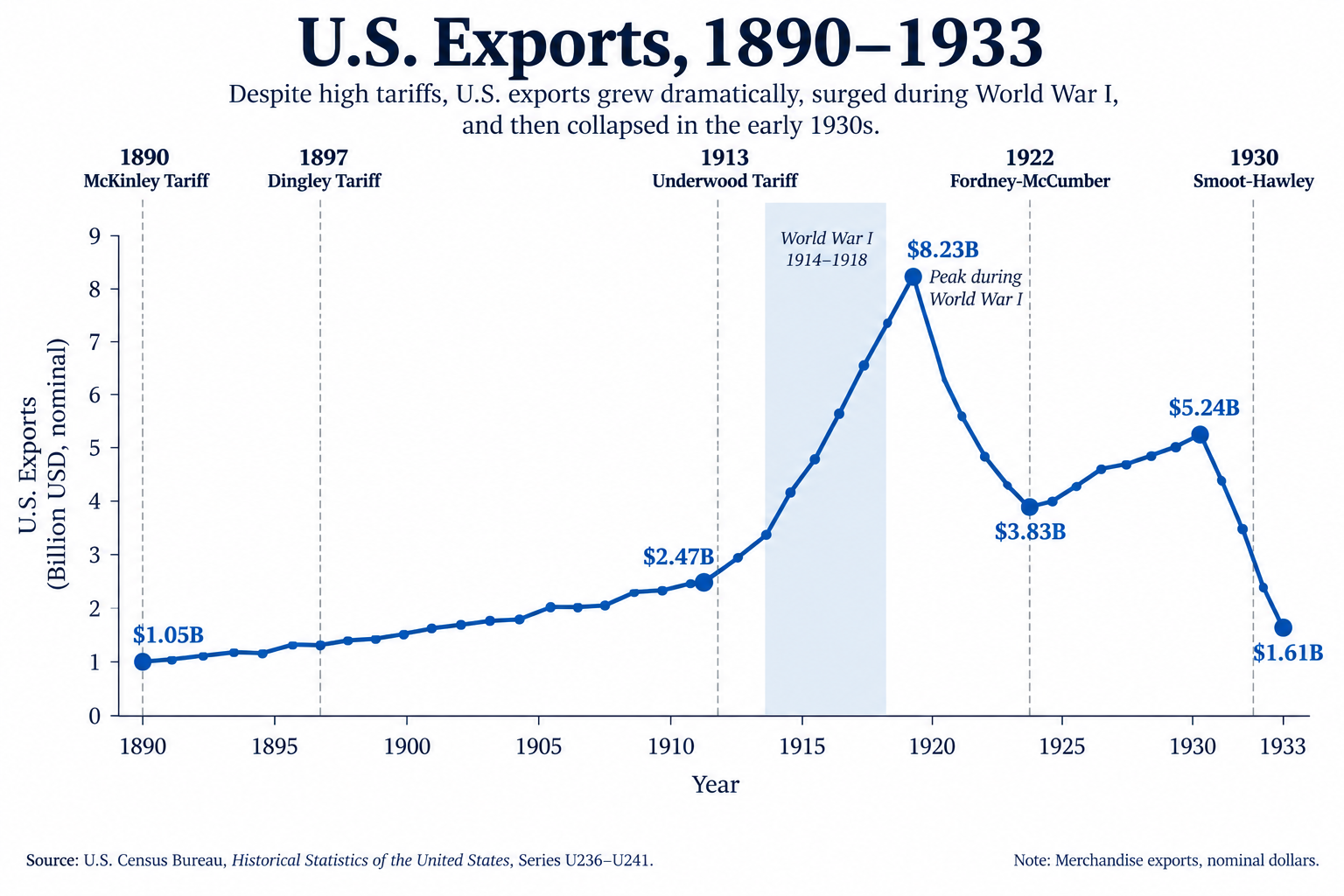
American exports grew tremendously.
Total U.S. exports were roughly $1 billion around the time of the Dingley Tariff. By the eve of World War I they were well above $2 billion annually. World War I then drove them dramatically higher.
American farms shipped grain and cotton abroad.
Petroleum reached foreign markets.
Steel production expanded.
Machinery became increasingly important.
Eventually American automobiles joined the list.
The domestic market was protected, but American companies still wanted foreign customers.
Imports Did Not Disappear Either
If tariffs were supposed to replace foreign goods with American goods, you might expect imports to steadily decline.
They did not.
Imports often fell after tariff increases.
But as America became wealthier, Americans bought more things. Factories also needed raw materials and intermediate goods.
Imports eventually resumed growing even while high tariffs remained in place.
That is one of the central contradictions of the period.
The United States was protecting domestic industry while becoming a larger participant in world trade.
Did Manufacturing Actually Grow?
Absolutely.
The harder question is why.
Economic historian Douglas Irwin has studied this period extensively and cautions against attributing America's industrial rise primarily to tariffs.
The United States had enormous natural resources, increasing capital investment, technological innovation, a growing population, improving transportation and one of the world's largest domestic markets.
All of those forces were pushing America toward industrialization.
Tariffs were part of that environment.
They were not the entire environment.
Some industries provide stronger evidence that tariffs accelerated domestic production.
Tinplate is a famous example. High tariffs helped establish domestic tinplate production earlier than it likely would have developed otherwise.
But that raises another question.
What did Americans pay while that domestic capacity was being built?
The Factory Worker Was Not Living in Paradise
If you look only at industrial production, this era can look spectacular.
If you look at the worker, it gets more complicated.
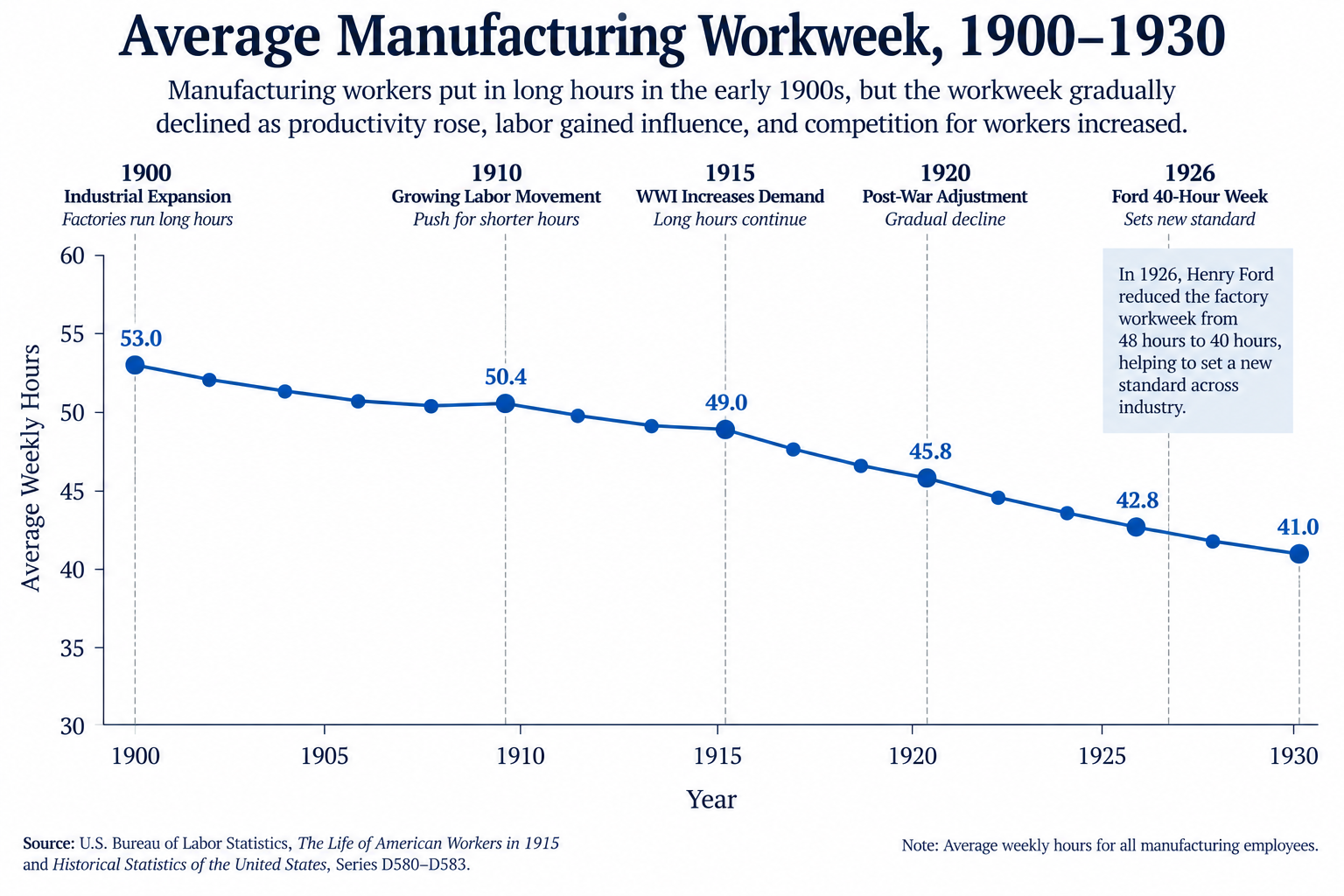
In 1900, the average manufacturing workweek was approximately 53 hours.
There was no Social Security.
No federal minimum wage.
No national unemployment insurance.
Workplace safety standards were nothing like today's.
And children worked.
The 1900 census found somewhere between 1.5 million and 2 million children engaged in wage labor.
So when we say American manufacturing was booming, we need to understand what manufacturing employment actually looked like.
It was often hard, dangerous work for long hours.
But Workers Did Become Better Off
Here is where the story turns again.
Despite those conditions, living standards generally improved over the longer period.
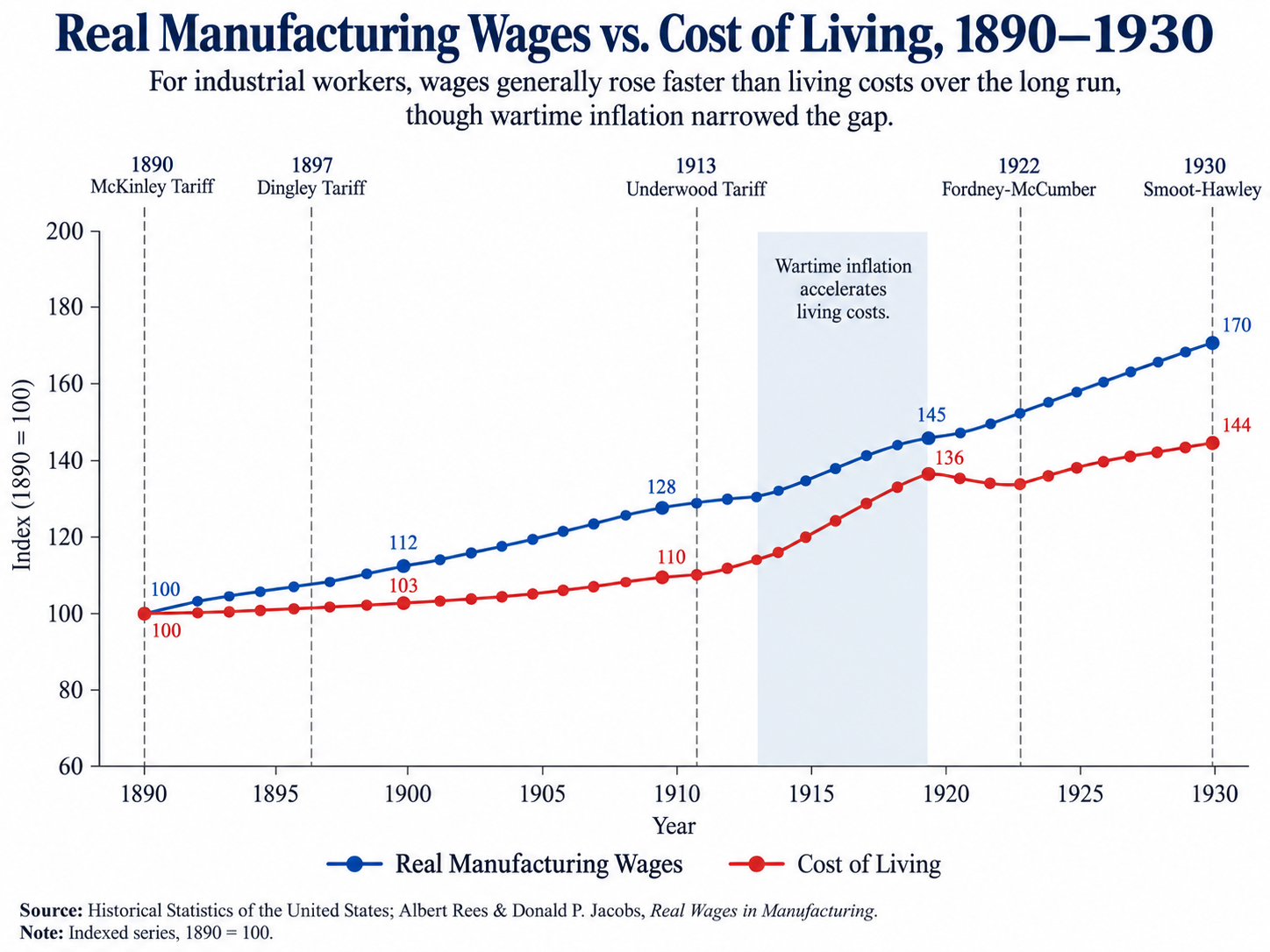
Historical research on manufacturing wages shows that real wages increased across much of the late 19th and early 20th centuries.
Real wages matter because a larger paycheck does not necessarily make someone wealthier if prices rise just as fast.
Viewed that way, American industrial workers generally made economic progress.
Workers also gained something else.
Time.
The manufacturing workweek gradually declined.
Labor organization, productivity improvements, political pressure and competition for workers all contributed.
Henry Ford famously reduced his factory workweek from 48 hours to 40 hours in 1926.
That did not happen because tariffs made employers generous.
It happened because the economy was becoming more productive and workers increasingly demanded a share of that productivity.
What About the Middle Class?
America was also developing a mass-consumption economy.
Cars transformed transportation.
Electricity spread.
Telephones became more common.
Appliances entered homes.
Consumer credit expanded.
By the 1920s, America increasingly looked recognizable to a modern observer.
People bought cars on installment plans.
They listened to radios.
They moved into suburbs.
They borrowed.
They consumed.
Mass manufacturing helped build a growing middle class.
But it would be a mistake to credit tariffs alone.
Tariffs existed alongside electrification, cheap energy, abundant resources, technological breakthroughs, immigration, capital investment and rapid productivity growth.
Tariffs Came Down, Then Came Back
In 1913, President Woodrow Wilson signed the Underwood Tariff and rates came down substantially.
The new federal income tax also meant Washington was less dependent on customs revenue.
Then World War I changed everything.
European manufacturing was disrupted. European countries needed food, raw materials and manufactured goods. American exporters filled the gap.
Exports surged.
American industrial capacity expanded further.
When the war ended, European production recovered and American farmers were left with too much supply and weaker foreign demand.
The political response was familiar.
Protect the American producer.
The Fordney-McCumber Tariff raised duties again in 1922.
Its supporters wanted to protect agriculture and manufacturing from lower-cost foreign competition.
The 1920s economy then boomed.
Automobile production surged.
Construction expanded.
Factories became more productive.
The stock market climbed.
Consumer credit flourished.
To someone standing in America in 1928, protectionism certainly did not appear to have destroyed prosperity.
But there was a structural problem overseas.
Europe owed enormous debts after World War I.
To repay American creditors, Europeans needed dollars.
One way to obtain dollars was to sell goods to Americans.
But America was making that harder through tariffs.
Meanwhile, the United States wanted foreigners to keep buying American exports.
You can see the tension.
We wanted to sell to them.
We wanted them to repay us.
And we wanted to limit what they sold to us.
Then Came 1930
The stock market crashed in October 1929.
The American economy was already contracting when Congress considered another tariff increase.
The result was the Smoot-Hawley Tariff of 1930.
It raised duties on thousands of imported products.
More than 1,000 economists urged President Herbert Hoover to veto it.
He signed it anyway.
Other countries retaliated.
Smoot-Hawley did not cause the Great Depression by itself.
Bank failures, monetary contraction, debt, collapsing investment, falling demand and the gold standard all played major roles.
What tariffs did was add another problem to an economy that already had plenty of them.
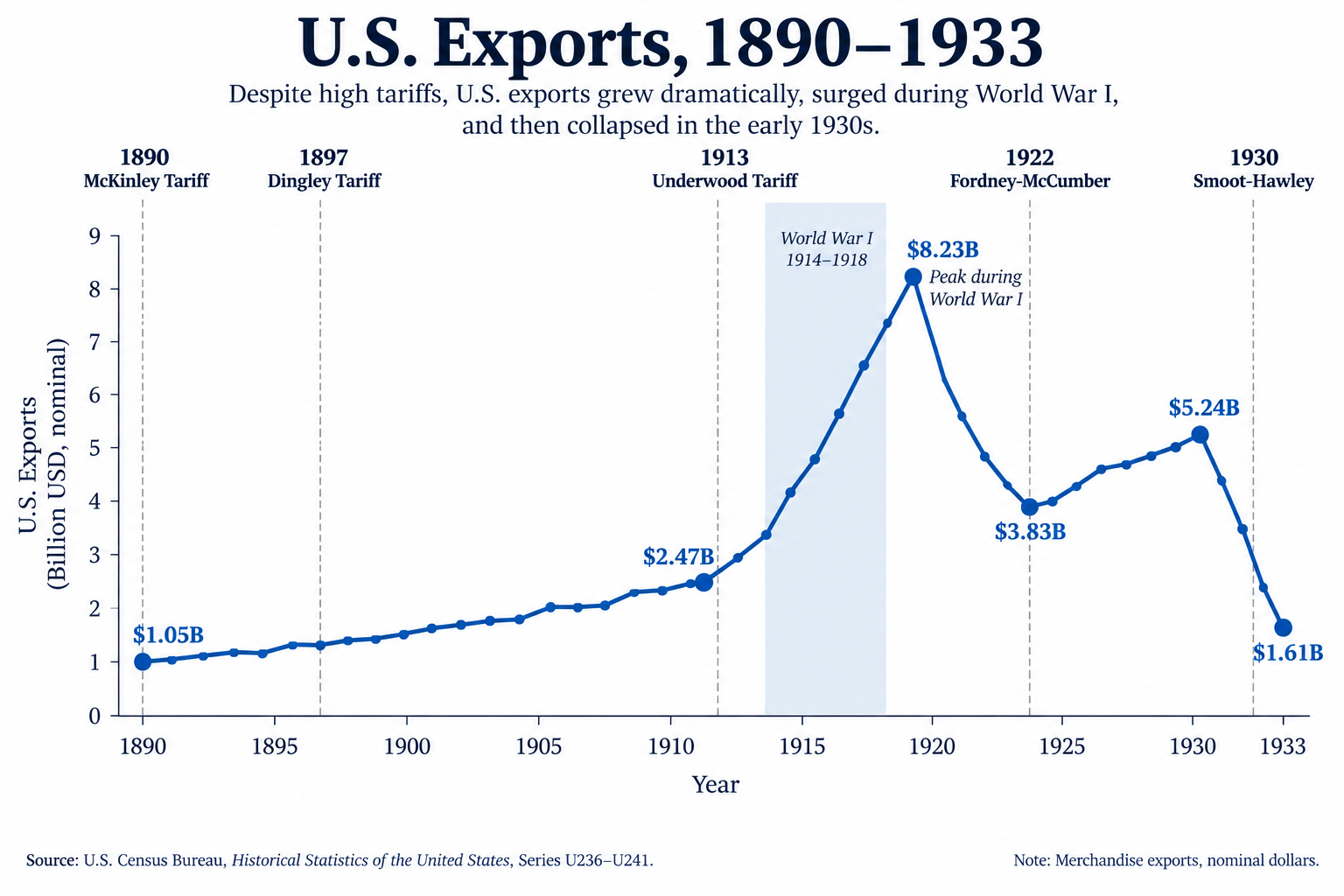
International trade collapsed.
American exports collapsed with it.
So Was the Tariff Era Good for Ordinary Americans?
If we define the period roughly as 1890 through 1929, the average American ended the period living in a much richer and more productive country than the one that existed at the beginning.
The population nearly doubled.
Industrial production expanded dramatically.
Real wages generally increased.
Working hours fell.
Mass-produced goods became available to ordinary households.
America became one of the world's dominant manufacturers and exporters.
From that perspective, it would be difficult to call the era an economic failure.
For much of the middle class, the long-term direction was clearly upward.
But calling it a golden age for workers would be misleading.
Working conditions were often dangerous.
Hours were long.
Child labor was widespread.
Economic downturns regularly destroyed jobs.
Workers had little financial protection when they were injured, unemployed or old.
Tariffs also made certain imported goods more expensive and protected domestic producers from competition, which could allow American companies to charge higher prices.
So the average worker occupied both sides of the tariff.
He might benefit because his factory was protected.
Then he went home and paid higher prices for something else protected by the same tariff.
The Most Important Thing the Numbers Tell Us
Tariffs cannot be examined in isolation.
America did not become an industrial giant simply because Congress taxed imports.
It had coal, iron, timber, oil and agricultural land.
It absorbed millions of immigrants.
It built railroads across a continent.
It developed massive capital markets.
It electrified factories.
It created new production methods.
And it built an enormous internal market.
Tariffs protected many manufacturers while all of that was happening.
Separating one factor from another is difficult.
Then the Strategy Reached Its Limit
Eventually, America faced a different problem.
Its industrial capacity had become enormous.
American companies could produce more than the domestic market alone could absorb.
They needed customers.
That made foreign markets increasingly valuable.
Protection at home became harder to reconcile with the desire to sell abroad.
Smoot-Hawley pushed that contradiction to an extreme at the worst possible time.
By 1934, the United States began moving toward reciprocal trade agreements.
The approach changed from simply protecting the home market to bargaining for access to foreign markets.
We lower some of our barriers.
You lower some of yours.
The philosophy changed.
Not because America's factories had disappeared.
Quite the opposite.
America had become so productive that selling to the rest of the world mattered more than it once had.
So What Actually Happened?
For roughly four decades, America conducted one of the most interesting economic experiments in its history.
It protected domestic industries with substantial tariffs.
Manufacturing expanded.
Government collected customs revenue.
Exports increased enormously.
Imports increased too.
Real wages generally improved.
Working hours declined.
The middle class expanded.
And America became an industrial superpower.
Then the weaknesses became harder to ignore.
A mature industrial economy needed foreign markets.
Trading partners could retaliate.
Protected industries could impose higher costs on consumers and other American businesses.
And when global trade began collapsing during the Depression, additional protection made an already terrible situation worse.
So were tariffs responsible for America's rise?
The historical record does not support such a simple conclusion.
But neither does it support the claim that high tariffs prevented America from becoming wealthy, industrial or globally competitive.
Both things happened at the same time.
The more interesting question is how much of America's rise happened because of tariffs, how much happened despite them, and what Americans paid while the transformation was taking place.
History usually refuses to give us the easy answer.

Editor-in-Chief, Concrete Logic
Seth Tandett is based in Richmond, Virginia, and has spent years working in the concrete construction industry across central and southern Virginia. His experience includes structural concrete work on multi-level frames, data centers, federal facilities, and other large-scale projects.
Today, Seth works in business development for Baker Construction and hosts the Concrete Logic Podcast, where he asks direct questions about what is really happening in the concrete industry.
Outside of work, Seth spends time studying economics, reading American history, and hunting waterfowl.
On the Concrete Logic Podcast, Seth brings the same approach he uses in the field: ask better questions, challenge weak answers, and focus on what actually matters in concrete.
You’re a Concrete Contractor in 1925. Business Has Never Been Better.