Are Data Centers Really the Big Wave for Concrete?

Bodhi had his wave. Construction has data centers. | Image: Point Break (1991), 20th Century Fox
Data centers are getting hammered right now. Some communities do not want them. Some people question the electricity and water they use. Others simply do not understand why we suddenly need so many of them.
Meanwhile, nearly every one of us is walking around with a direct connection to a data center sitting in our pocket. Your phone, email, photos, banking, streaming, cloud storage and artificial intelligence all have to live somewhere.
Like them or not, data centers have become one of the hottest parts of the construction economy.
Recently, I saw a chart making the rounds among stock-market investors and analysts. One line showed data-center construction spending shooting upward. The other showed the rest of private construction heading down.
That chart explains why seemingly everyone in construction is chasing data centers right now. It reminds me of Bodhi from Point Break. He spent his life chasing the ultimate wave. Right now, data centers look like construction's ultimate wave.
Ready-mix producers want them. Concrete contractors want them. Suppliers want them. General contractors are building entire advanced-technology teams around them.
But before we all paddle out after the same wave, how big is the data-center pie for concrete when we stop measuring it in dollars and start measuring it in pounds of cement and cubic yards of concrete?
The Spending Numbers Are Hard to Ignore
U.S. private construction spending was running at a seasonally adjusted annual rate of about $1.614 trillion in July 2026, down from about $1.684 trillion in December 2023. Data centers moved hard in the opposite direction.
Private data-center construction was running near $24 billion annually at the end of 2023. By July 2026, it was about $75 billion. That is an increase of roughly $51 billion while total private construction fell about $69 billion.
Subtract the data-center growth and the rest of private construction was down roughly $120 billion from the December 2023 annualized pace, about a 7% decline. These are nominal dollars, so they are not adjusted for increases in construction costs.
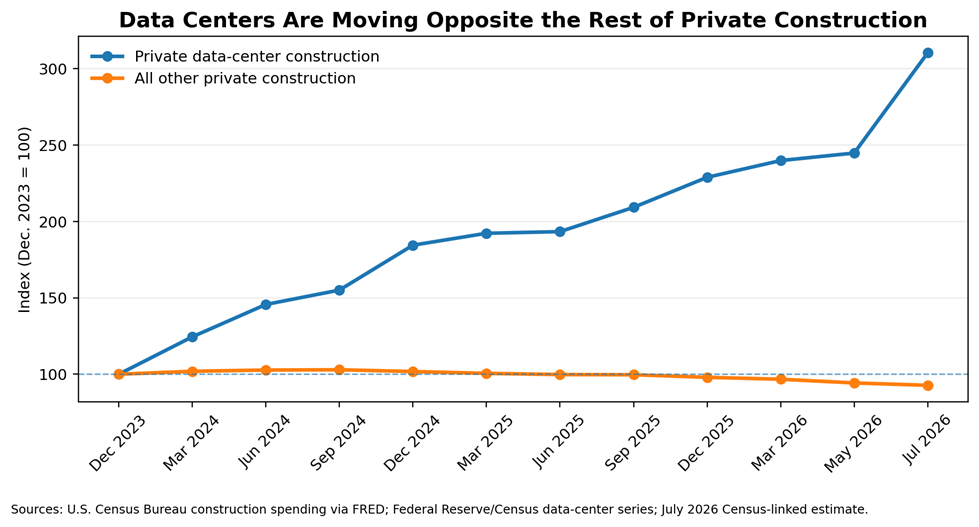
Figure 1. December 2023 = 100. “Other private construction” is total private construction less private data-center construction.
A Billion-Dollar Data Center Is Not a Billion-Dollar Highway
Here is where the concrete story changes.
Data centers are incredibly expensive buildings, but much of that cost never touches a ready-mix truck. The American Cement Association estimates that 45% to 70% of a new data center's cost can be electrical, HVAC and plumbing. It estimates that structural components account for about 30% of the total data-center budget, compared with about 55% for a typical office building.
ACA estimates data centers have about 66% of the cement intensity of traditional office construction per construction dollar. In plain English, a dollar of data-center spending does not buy nearly as much cement as the same dollar spent on a more concrete-intensive project.
ACA projected data-center construction would consume about 290,000 metric tons of cement in 2026. That is about 639 million pounds of cement.
Using a simple six-sack mix equivalent of 564 pounds of cement per cubic yard, 290,000 metric tons represents the cement content of roughly 1.13 million cubic yards of concrete. That is not an estimate of actual ready-mix volume. Mix designs vary, SCM replacement varies, and some cement goes into precast and other products. It is simply a way to understand the scale.
Now Compare That With Where the Cement Really Goes
The American Cement Association's U.S. industry snapshot, based on 2024 market data, puts the scale of several familiar sectors into perspective:
| Sector | Cement | 6-sack concrete equivalent* |
| Highways, streets and bridges | 31.1 million MT | ~121.5 million yd³ |
| Single-family housing | 20.1 million MT | ~78.6 million yd³ |
| Levees, dams and culverts | 2.6 million MT | ~10.2 million yd³ |
| Schools | 1.9 million MT | ~7.4 million yd³ |
| Oil and gas wells | 1.9 million MT | ~7.4 million yd³ |
| Data centers, 2026 projection | 0.29 million MT | ~1.13 million yd³ |
*Concrete-equivalent figures are a scale comparison only, calculated at 564 lb of cement per cubic yard. They are not actual ready-mix production volumes.
That comparison should change the way we look at the opportunity. Data centers are a fast-growing, high-dollar market, but highways alone consume more than 100 times the cement represented by ACA's 2026 data-center projection.
The concrete volume is not hiding in some exotic new market. A lot of it is sitting in roads, bridges, schools, water infrastructure and energy work that we have been driving past for years.
Meanwhile, Total Cement Demand Is Going the Wrong Way
USGS estimates apparent U.S. cement consumption peaked at about 114 million metric tons in 2022, slipped to 113 million in 2023, and fell to about 110 million in both 2024 and 2025. ACA is forecasting another 2.5% decline in 2026.
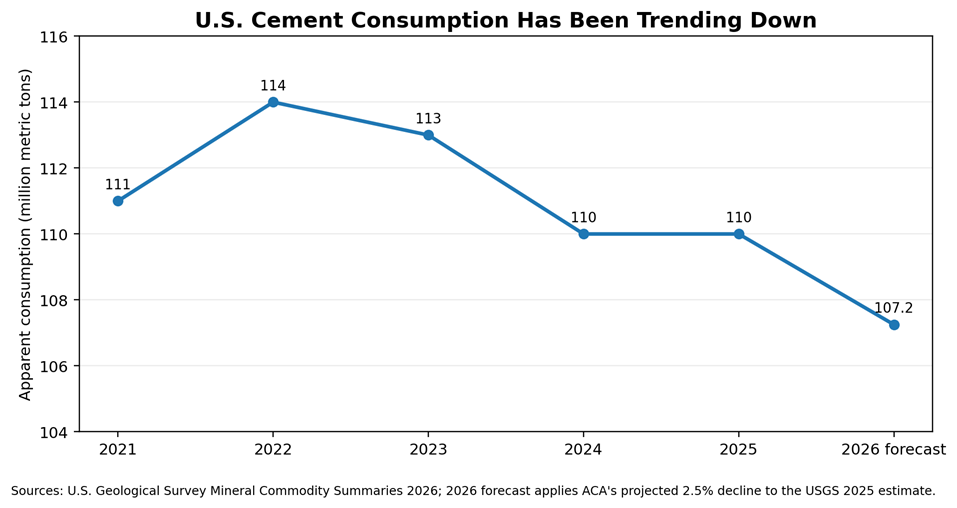
Figure 2. U.S. apparent cement consumption. 2026 is a forecast, not an actual result.
That is why data centers cannot carry the whole concrete industry. They can be a great market and still be too small, in cement terms, to offset weakness everywhere else.
Then the Canadian Cement Tariff Disappeared
This backdrop also makes the recent Canadian cement tariff reversal interesting.
The federal government imposed an additional 50% duty on covered Canadian products, including cement, in August. On September 8, the White House modified the product list and removed certain products from the additional duty. Cement was among the products removed, with the change taking effect in September.
The White House did not say declining construction or cement demand caused the change, so we should not claim that it did. But the timing is worth noticing: private construction outside data centers was weakening, cement consumption was already trending down, and a large tariff had just been placed on an important construction input.
Maybe those facts were connected. Maybe they were not. Either way, the broader construction numbers help explain why another large material-cost increase would have mattered.
Get a Piece of the Pie Before It Turns Sour
So should concrete companies chase data centers? Yes.
Get a piece of the data-center pie while the spending is there and the margins are strong. Build the relationships. Learn the specifications. Figure out the schedule pressure, quality requirements and risk. Become good at the work.
But do not assume this wave lasts forever.
Use those margins to expand your capabilities into the sectors where the concrete volume is hiding in plain sight.
Think schools and universities. Roads and bridges. Airports. Water and wastewater. Power generation. Natural gas infrastructure. Refining and petrochemical work. Heavy civil and other public infrastructure.
Do not just chase individual projects in those markets. Build teams that can operate expertly in them. Learn public procurement and DOT specifications. Understand aviation concrete. Learn the documentation, testing and quality systems required by energy owners. Become an expert instead of a tourist.
Data centers can help pay for that investment.
Eventually, every wave breaks. The companies in the strongest position will not necessarily be the ones that chased data centers the hardest. They will be the ones that used today's margins to build capabilities in the markets that keep consuming concrete after the headlines move somewhere else.
Get your piece of the data-center pie now, before it turns sour. Then use it to build expertise in the sectors where the real concrete volume has been hiding in plain sight.

Editor-in-Chief, Concrete Logic
Seth Tandett is based in Richmond, Virginia, and has spent years working in the concrete construction industry across central and southern Virginia. His experience includes structural concrete work on multi-level frames, data centers, federal facilities, and other large-scale projects.
Today, Seth works in business development for Baker Construction and hosts the Concrete Logic Podcast, where he asks direct questions about what is really happening in the concrete industry.
Outside of work, Seth spends time studying economics, reading American history, and hunting waterfowl.
On the Concrete Logic Podcast, Seth brings the same approach he uses in the field: ask better questions, challenge weak answers, and focus on what actually matters in concrete.
America’s Long Experiment With Tariffs