Could One Steel Mill Slow America's Next Construction Boom?
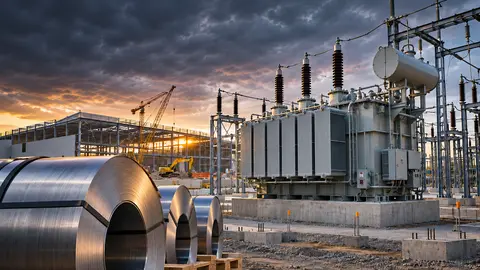
A cornered market. Just what our electric bills needed. | AI-generated
Imagine spending a billion dollars building a new manufacturing facility. The concrete is placed, the steel is erected, the equipment is installed, and the contractors are wrapping up their punch lists.
Everything is ready to go.
Except you can't turn the power on.
Not because the utility doesn't have enough electricity. Not because the electricians didn't finish their work. But because a transformer that was ordered two years ago still hasn't shown up.
Sounds ridiculous, doesn't it?
Unfortunately, there's a very real supply chain problem developing in America's electrical infrastructure. And it leads back to a type of steel most people have probably never heard of.
The Steel Nobody Talks About
Most of us in construction are familiar with structural steel, reinforcing steel, and the steel used in equipment and machinery.
But there's another type called grain-oriented electrical steel, or GOES.
It's a specialty steel manufactured specifically for its magnetic properties. Thin sheets of it are stacked together to make the cores inside electrical transformers. Those cores help transfer energy between electrical circuits while minimizing energy losses.
Transformers are everywhere. They step voltage up to move electricity across the country and step it back down so we can use it in our homes, businesses, and industrial facilities.
Whether we're talking about a new data center, an LNG terminal, a semiconductor plant, or a neighborhood subdivision, transformers are part of getting that project connected to the grid.
Here's what surprised me.
The United States has only one domestic manufacturer of grain-oriented electrical steel.
That company is Cleveland-Cliffs, which produces GOES at its Butler Works facility in Pennsylvania. A 2026 Congressional Research Service report highlights how dependent America's transformer supply chain has become on limited domestic production and imported materials.
Let that sink in for a minute.
We're spending hundreds of billions of dollars expanding electrical generation, transmission, manufacturing, and data centers. Yet the domestic supply of a critical material used inside conventional transformers comes from one manufacturer.
We do import electrical steel from other countries, so it's not as though Butler Works is our only source. But relying on imported specialty steel creates another set of problems.
And those problems are starting to show up on construction schedules.
When the Transformer Takes Longer Than the Building
According to Wood Mackenzie, average lead times for large power transformers reached approximately 128 weeks in 2025. Generator step-up transformers, the massive units used at power plants, averaged approximately 144 weeks.
That's roughly two and a half to three years.
Some specialized transformers take even longer.
Now think about that from a construction perspective.
A developer announces a new industrial facility. The design team gets moving. Contractors bid the work. The site is cleared, foundations are placed, and construction proceeds.
But the electrical equipment needed to operate the facility may have to be purchased before much of that work begins.
And if that equipment slips six months?
The building might be finished, but the owner still can't put it to work.
Of course, not every transformer has a three-year lead time. Smaller distribution transformers are a different market, and some of those delivery times have improved. The real trouble is often with large, specialized equipment that can't simply be pulled off a warehouse shelf.
This isn't just a scheduling inconvenience.
Someone has money tied up in that facility. There may be construction financing, equipment leases, insurance, and employees hired in anticipation of startup. Depending on the contracts, delays can create expensive disputes over who is responsible.
All because a critical piece of equipment isn't available.
Making More Steel Isn't Quite That Simple
Here's another interesting twist.
It's not necessarily enough to have more domestic electrical steel. We need the right kind.
An August 2026 analysis from the Breakthrough Institute points out that some U.S.-manufactured GOES doesn't match the dimensions or energy-efficiency performance of higher-grade products manufactured overseas.
Certain transformer manufacturers need wider sheets of steel or particular magnetic properties that domestic production doesn't currently provide competitively.
That's a problem you can't necessarily solve by telling the existing steel mill to increase production.
You may need new equipment, updated manufacturing processes, and considerable capital investment.
There are also tariffs involved. Imported electrical steel and certain transformer components face additional duties that can raise costs for manufacturers already struggling to meet demand.
Protecting domestic steel production makes sense as an objective. So does having access to the materials needed to build our electrical infrastructure.
But what happens when those two objectives work against each other?
That's worth paying attention to, especially when the resulting costs eventually find their way into utility bills and construction budgets.
Virginia Is Trying to Help Solve the Problem
Here's where this gets interesting for those of us in Virginia.
In June, Hitachi Energy broke ground on a $457 million expansion of its transformer manufacturing facility in South Boston, Virginia.
The project is expected to create approximately 825 jobs and establish what Hitachi describes as the country's largest manufacturing facility for large power transformers.
That's a substantial investment, and it's happening in a part of Virginia that has also seen a lot of interest in data centers, energy infrastructure, and advanced manufacturing.
But building a factory that makes transformers doesn't automatically solve the transformer shortage.
You still need electrical steel, copper, specialized manufacturing equipment, and workers who know how to assemble these highly engineered products.
You also need time.
Transformer manufacturing isn't something you can scale overnight by adding a second shift. These are specialized products that require highly trained workers, precise manufacturing, and extensive testing.
McKinsey recently described the transformer industry as entering a supercycle, with global demand expected to grow about 40% by 2035.
That's a tremendous opportunity for manufacturers.
It's also another reminder that the supply chains supporting construction have become just as important as the work happening on construction sites.
What Does This Mean for Concrete Contractors?
You might be wondering why a concrete guy is writing about electrical steel.
Fair question.
Think about the projects being built right now.
Data centers need substations. Power plants need massive transformers. Advanced manufacturing facilities need dependable electrical infrastructure. Even municipal water and wastewater facilities rely on electrical equipment to operate their pumps and treatment systems.
All of those projects require concrete.
Foundations, equipment pads, containment structures, buildings, utility infrastructure. There's plenty of concrete involved.
But the availability of that work, the sequencing of construction, and ultimately when owners can start using their facilities are increasingly tied to equipment manufactured somewhere else.
We spend a lot of time worrying about concrete delivery schedules, labor availability, and whether reinforcing steel will arrive when we need it.
Meanwhile, an electrical component with a three-year procurement schedule might be determining the completion date of the entire project.
For contractors, that raises some questions.
Are owners actually accounting for these lead times when they establish project schedules?
Are long-lead electrical packages being purchased early enough?
And when equipment gets delayed, who's paying for the resulting disruption to the construction schedule?
I suspect we'll hear more about those questions as increasingly large industrial projects compete for limited electrical equipment.
The Bigger Picture
There's been a lot of discussion about whether America has enough electricity to support all the data centers, factories, and infrastructure we're planning to build.
But generating electricity is only part of the equation.
We also have to move it.
And moving it requires equipment that depends on a surprisingly complicated global supply chain.
A November 2026 analysis of transformer supply-chain security from the Climate Leadership Council highlights another concern: Even when transformers are assembled outside China, the manufacturers may still depend on Chinese components and electrical steel.
That means bringing final assembly back to the United States doesn't necessarily eliminate our dependence on foreign suppliers.
We can approve new power plants, build new transmission corridors, and construct massive industrial facilities. But if the equipment needed to connect everything together isn't available, we've got a problem.
The good news is that companies are investing billions to expand domestic manufacturing. The bad news is that those investments take years to translate into finished equipment.
I find it fascinating that one of the biggest constraints on America's construction ambitions could be something as obscure as the magnetic properties of a thin sheet of steel.
We're pretty good at figuring out how to build bigger and faster.
Maybe we need to spend a little more time figuring out whether we can actually supply everything those projects need.

Editor-in-Chief, Concrete Logic
Seth Tandett is based in Richmond, Virginia, and has spent years working in the concrete construction industry across central and southern Virginia. His experience includes structural concrete work on multi-level frames, data centers, federal facilities, and other large-scale projects.
Today, Seth works in business development for Baker Construction and hosts the Concrete Logic Podcast, where he asks direct questions about what is really happening in the concrete industry.
Outside of work, Seth spends time studying economics, reading American history, and hunting waterfowl.
On the Concrete Logic Podcast, Seth brings the same approach he uses in the field: ask better questions, challenge weak answers, and focus on what actually matters in concrete.
America Has Plenty of Natural Gas. So What's Holding Up the Power?